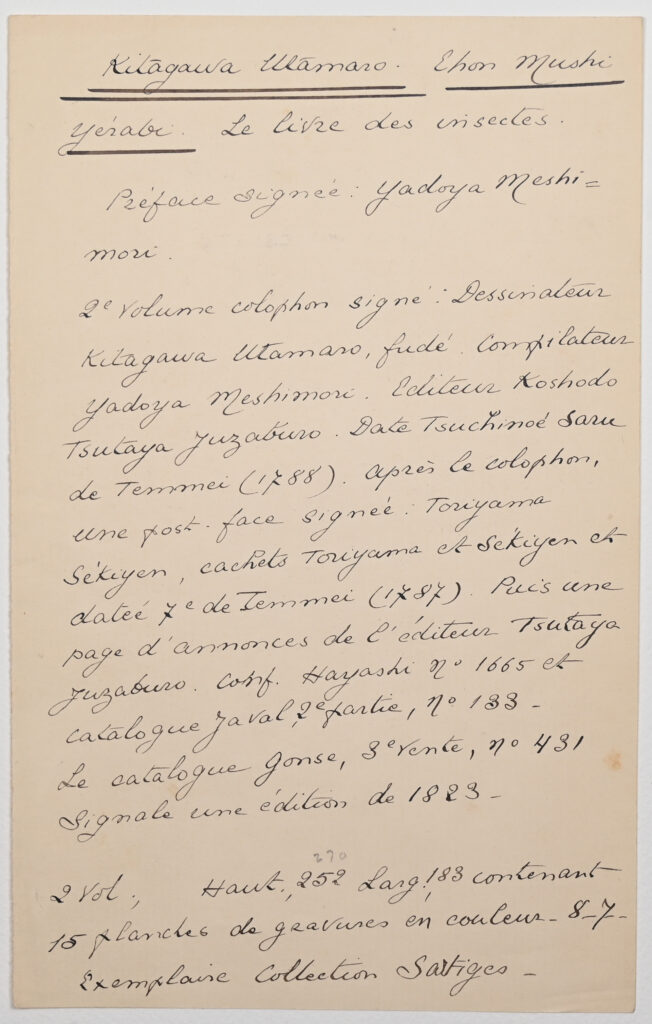
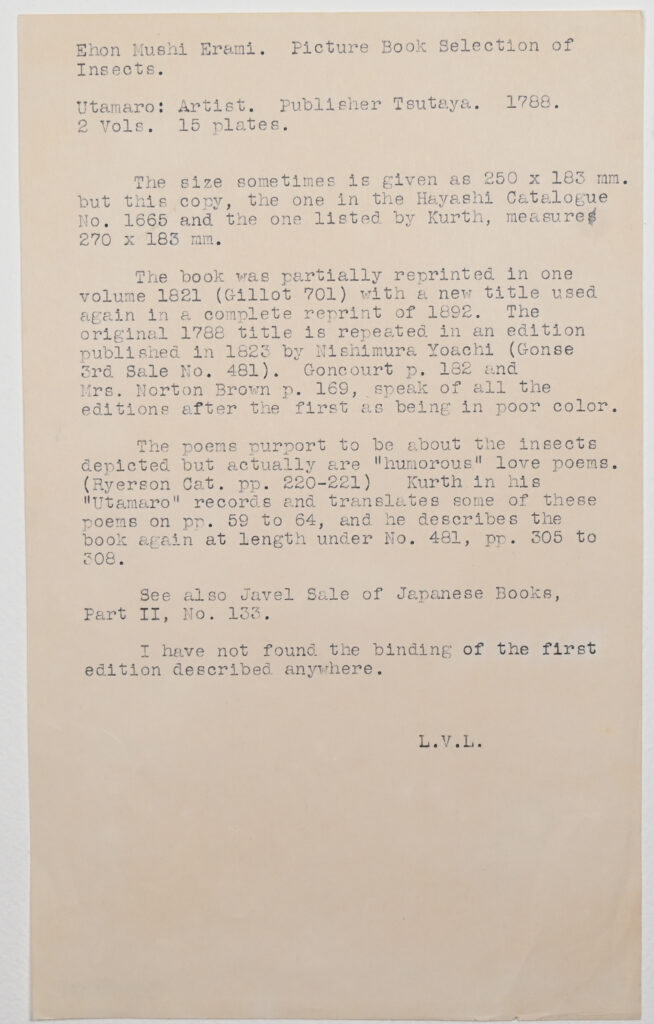
Title
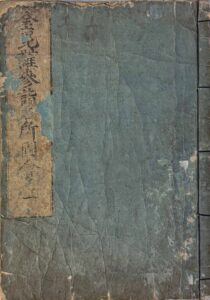
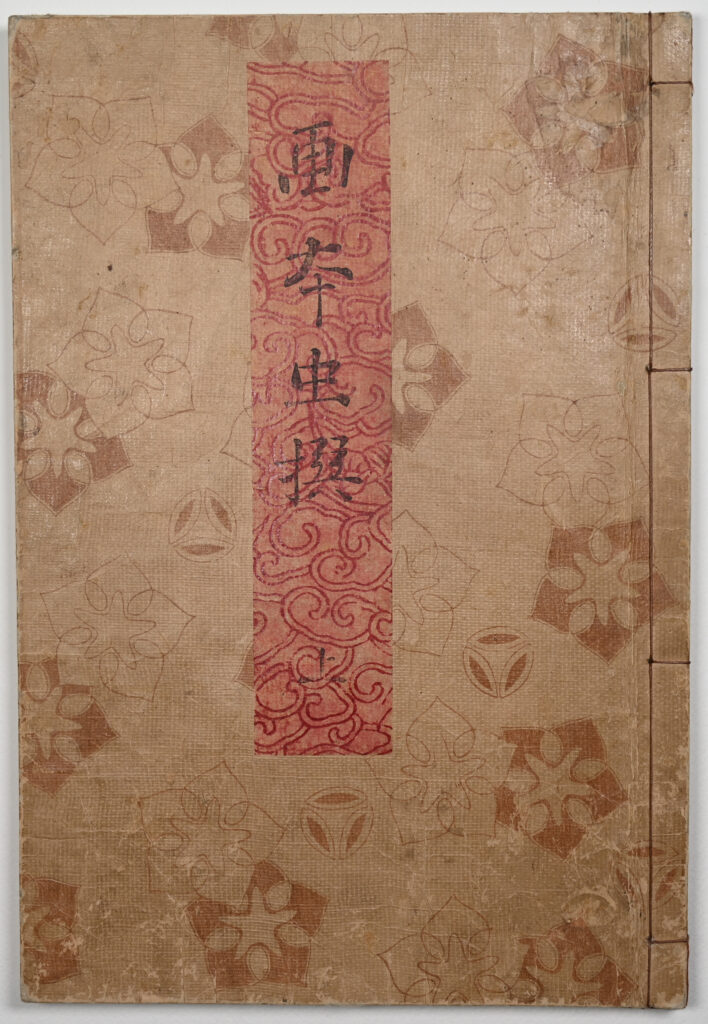
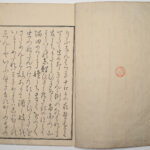
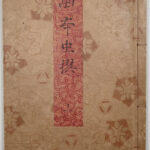
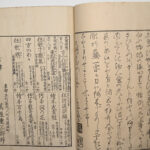
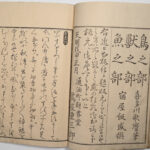
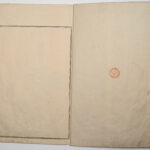
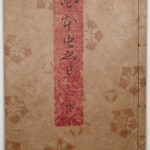
Ehon mushi erabi jō 画本虫撰 上 (Picture Book of Crawling Creatures, vol. I)
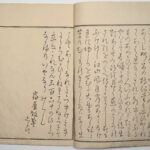
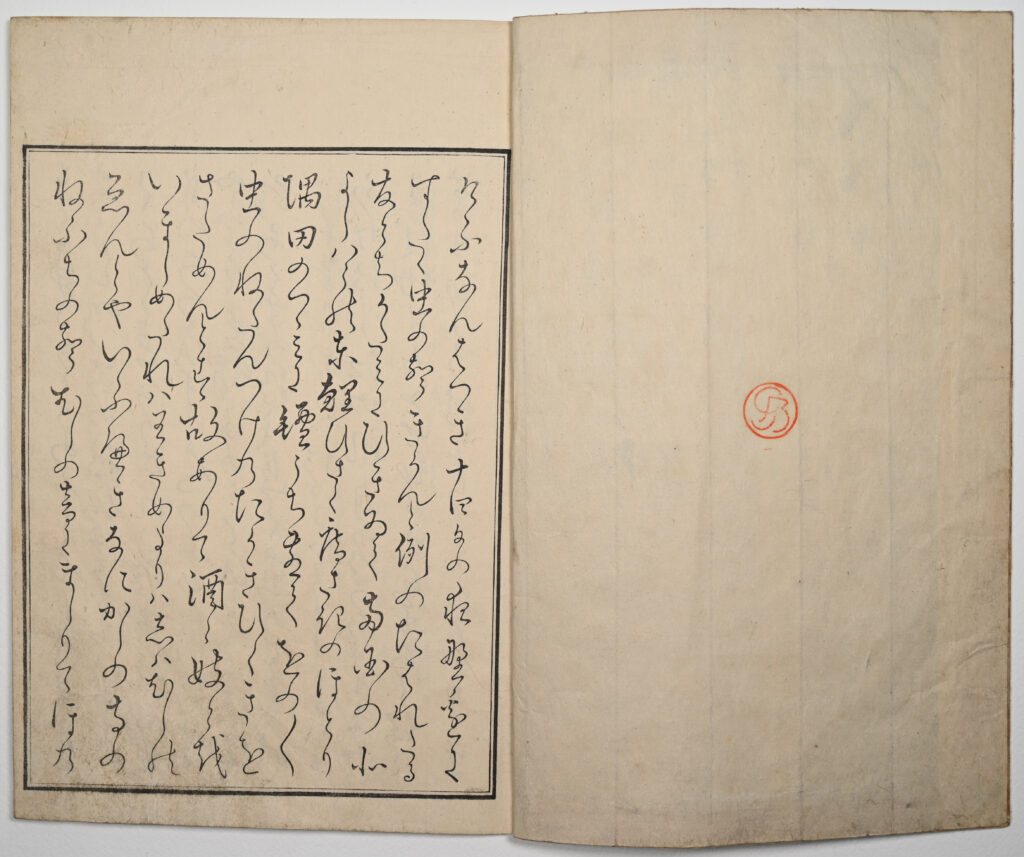
けふなんはつき十四日の夜野辺にすたく虫の声きかんと例のたはれたる友とちかたみにひきゐて両国の北よしはらの東鯉ひさく庵さきのほとり隅田のつゝみに氈うち敷てをの/\虫のねたんつけのたかきひくきをさためんとす故ありて酒と妓とをいましめたれはわきめよりはしはむしのゑんとやいふへきなにかしの寺のねふちの声むしの音にましりてほの…
(On this, the night of the fourteenth of the eighth month, the usual group of comic poets dragged one another along to listen to the voices of the insects that chirp in the fields. North from Ryōgoku and east of Yoshiwara, we spread out our rugs on the embankment of the Sumida River near Iosaki, where they sell carp [and love], and tried to fix a value on the voice of each insect, high or low. By force of circumstance we forwent wine and women, and so any females in the parties nearby must have said that we were a group of stingy worms. Intoned prayers from a nearby temple mingled faintly with the sounds of the insects...[Trans. by John T. Carpenter])
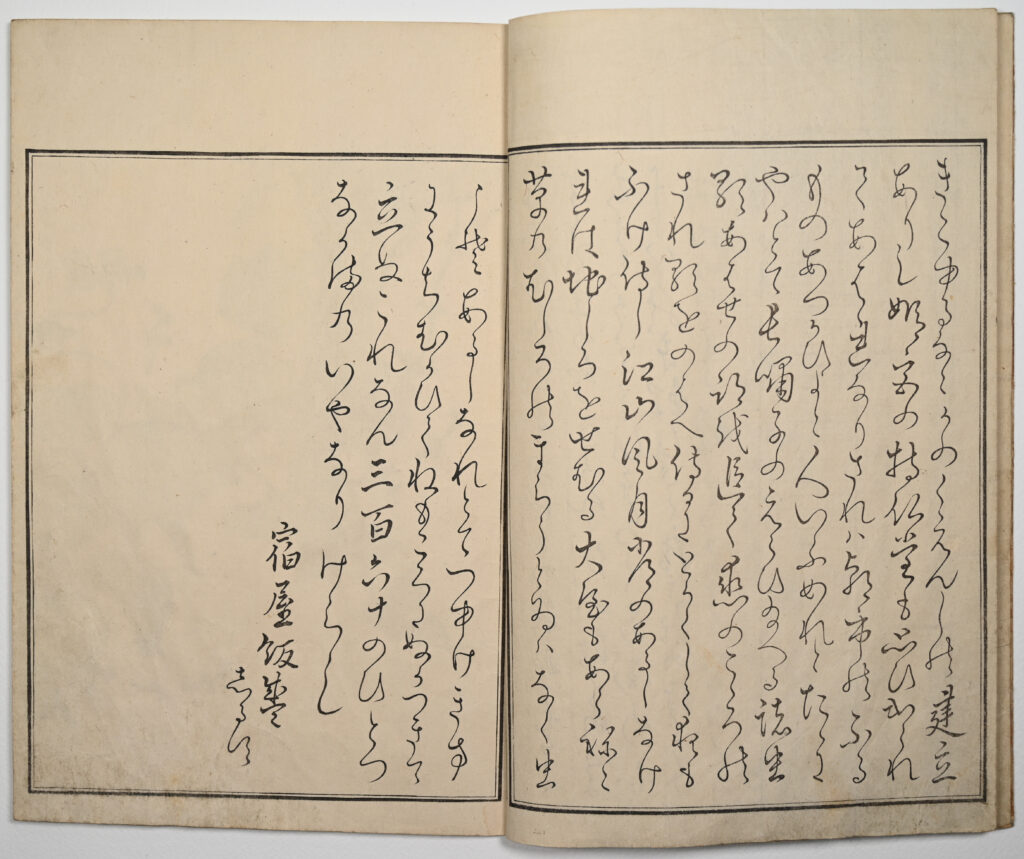
…きこゆるなとかのくえんしの建立ありし姫宮の持仏堂も思ひ出られてあはれなりされは朝市のふるものあつかひよと人いふめれとたゝにやハとて長嘯子のえらひ給へる諸虫歌あはせの跡を追て戀のこゝろのされ歌をのはへ侍るにとかくして夜もふけ待し江山風月常のあるしなけれは地しろをせむる大屋もあらねと草のむしろのまらうとゐはなく虫こそあるしなれとてつゆけき方にうちむかひてねもころにぬかつきて立ぬこれなん三百六十のひとつなかまのいやなりけらし
(...reminding us sadly of that unusual Buddhist shrine made for an empress [perhaps referring to the seventh-century Tamamushi ("Jewelled Beetle") Shrine at Hōryūji Temple made for Empress Suiko]. We thought that it would be simply inexcusable for people to accuse us of selling old leftovers at the morning market and so, hot on the heels of the Poetry Contest on Various Insects compiled by [Kinoshita] Chōshōshi, we have composed kyōka [playful poems] on the sentiments of love. Thus we whiled away the night. Since river and mountain, wind and moon have no habitual master, there was no landlord pressing for the rent. And since there was no reception room on our grassy mat, we decided that the [singing] insects must be the true owners. Turning to face these dew-covered personages, we politely bow down low and can’t stand up!
[Trans. and comm. by John T. Carpenter])
宿屋飯盛しるす (Written by Yadoya no Meshimori[Ishikawa Masamochi])
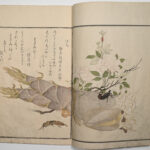
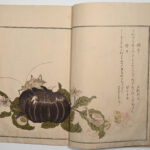
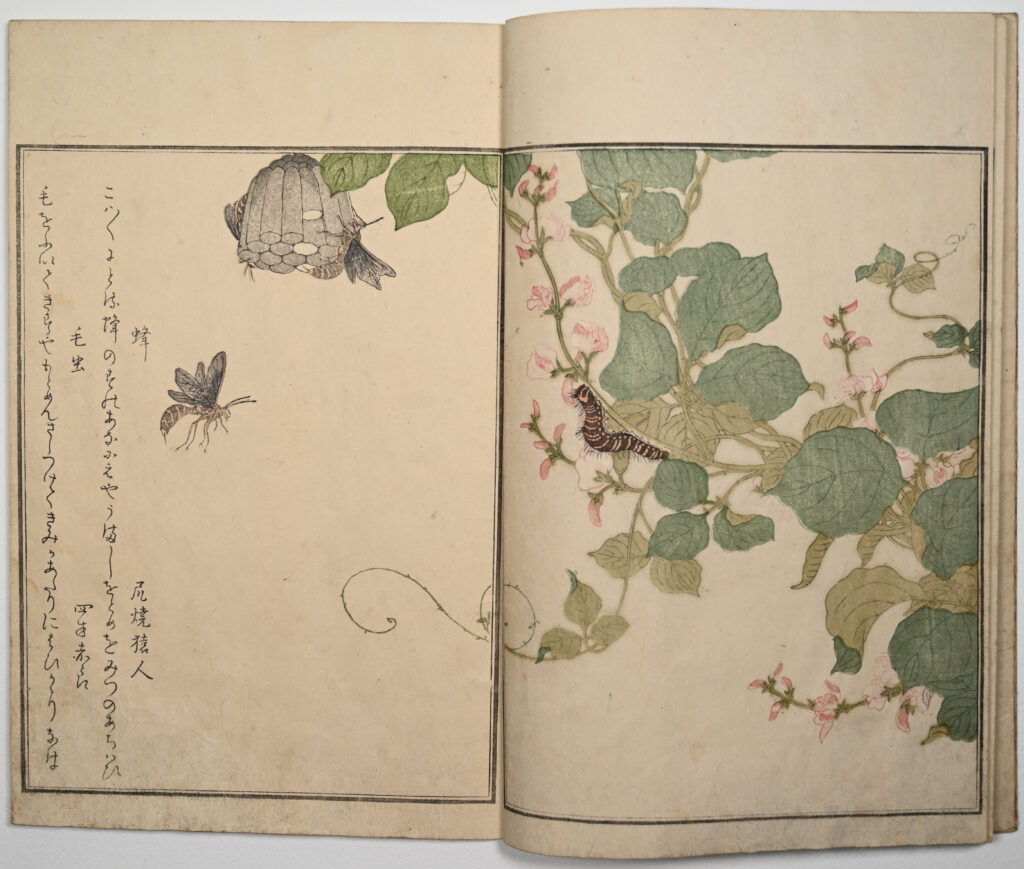
蜂 尻焼猿人
こは〳〵にとる峰のすのあなにはやうましをとめをみつのあちはひ
(Paper Wasp, hachi[Order: Hymnoptera. Genus: Polistes]
Shiriyake no Sarundo [Sakai Hōitsu]
Like reaching into
the opening of a beehive,
I’m timid when meeting
a lovely young maiden
who tastes sweet as honey.)
The artist has depicted paper wasps by their nest, but hachi also means honeybee (Apis mellifera), which is the insect referred to in the poem. In the poem, ana is a pivot word, first as the last word of the phrase hachi no su no ana, "opening of a beehive," and then as part of ananieya, an exclamatory form of praise for a beautiful young woman. Umashi otome (lovely maiden) alludes to the legend of male and female deities Izanagi and Izanami as recounted in Japanese creation myths. Mitsu is first used as the verb "to see" and then as the noun "honey." Shiriyake no Sarundo (1761–1828) is the poetry name of the noted painter Sakai Hōitsu, founder of the Edo branch of the Rinpa school. He was active in the poetry circles of Akera Kankō and Santō Kyōden in the 1780s.
Trans. and comm. by John T. Carpenter
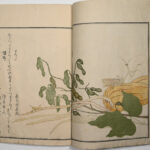
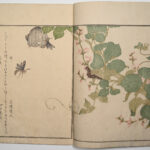
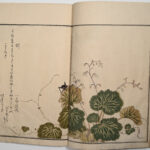
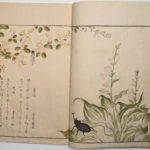
毛虫 四才赤良
毛をふいてきすやもとめんさしつけてきみかあたりにはひかゝりなは
(Hairy Caterpillar, ke-mushi [Order: Lepidoptera. Family: Arctiidae]
Yomo no Akara [Ōta Nanpo]
If I crawl all over you,
I'll only get stung badly,
since , as the saying goes,
"if you blow on another's hair
your own faults will show!")
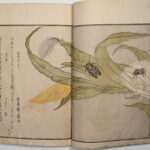
A hairy caterpillar crawls upside down on the stem of a flowering vine. The opening two lines of the poem link the ke-mushi, "hairy insect’, with an old Japanese saying: ke o fuite kizu o motomeru, literally, "If you blow on someone’s hair you will find a wound." The phrase implies that if you try to find someone else’s hidden faults, your own will be exposed – and is thus used in the sense of the English saying, "let sleeping dogs lie." Yomo no Akara (1749–1823) was the pen name of Ōta Nanpo, a low-ranking samurai official who was one of the foremost literati arbiters of his day. He was better known in later years by the pen name Shokusanjin.
Trans. and comm. by John T. Carpenter.
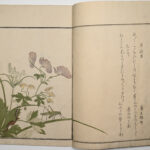
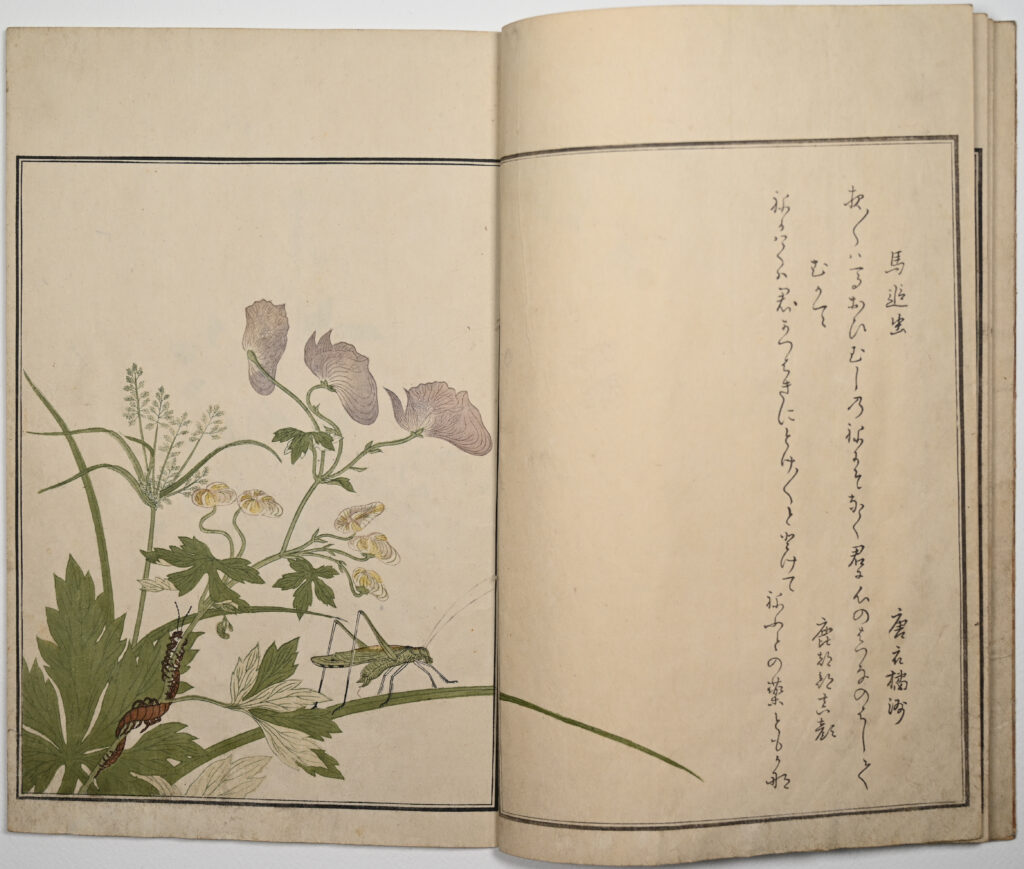
馬追虫
唐衣橘洲
夜〳〵は馬おひむしのねにそなく君に心のはつなのはして
(Katydid, umaoi-mushi [Order: Orthoptera. Family: Tettigoniidae]
Karagoromo Kisshū [Karagoromo Kisshū]
Night after long night,
I neigh and neigh
like a "horse-driving" insect,
as the halter on my heart
stretches out towards you.)
The katydid balances on a leaf of the sedge plant. The poem uses equestrian punning on the Japanese name for the katydid, umaoi-mushi, literally "horse-driving insect." A related Japanese phrase "horse of the emotions" (kokoro no uma or koma) refers to unbridled passions. The poet Karagoromo Kisshū (or Kijū; 1743–1802), of samurai extraction, was skilled in both classical court poetry and kyōka. A gathering of literary friends held in Kisshū’s own home in 1769 is often cited as marking the beginning of the Tenmei kyōka movement in Edo.
Trans. and comm. by John T. Carpenter
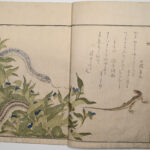
むかて
鹿都部真顔
ねかはくは君かつはきにとけ〳〵とけてねふとの薬ともかな
(Centipede, mukade [Class: Chilpeda]
Shikatsube no Magao [Yomo no Magao]
If I could have my wish,
I would be close to you
sleeping soundly by your side,
so your saliva could melt me
into a balm for curing boils.)
A centipede clings to a stalk of aconite (Aconitum chinense). The ‘saliva’ of a centipede (actually a secretion from glands in its front legs) referred to in the poem is actually toxic, but the poem is composed in the voice of the centipede, who would like to be licked by his lover until he dissolves into traditional East Asian medicine made from ground centipedes (used as an ointment for treating boils among other ailments). Ne is a pivot word, first as part of the expression tokedoke to ne[ru], to "sleep soundly," and then as part of nebuto (boil). Tokete also suggests that the insects are "opening their hearts" to each other. Furthermore, according to Japanese folklore, a centipede can be killed by human spit. For instance, in the folktale about the early tenth-century courtier Tawara (Ricebag) no Tōda Hidesato, he licked the points of arrows that he would use to kill the monster centipede at Mt Mikami. The poet Shikatsube no Magao (1753–1829), better known as Yomo no Magao, was one of the great kyōka masters of the age, and headed the Yomo (Four Quarters) poetry club.
Trans. and comm. by John T. Carpenter
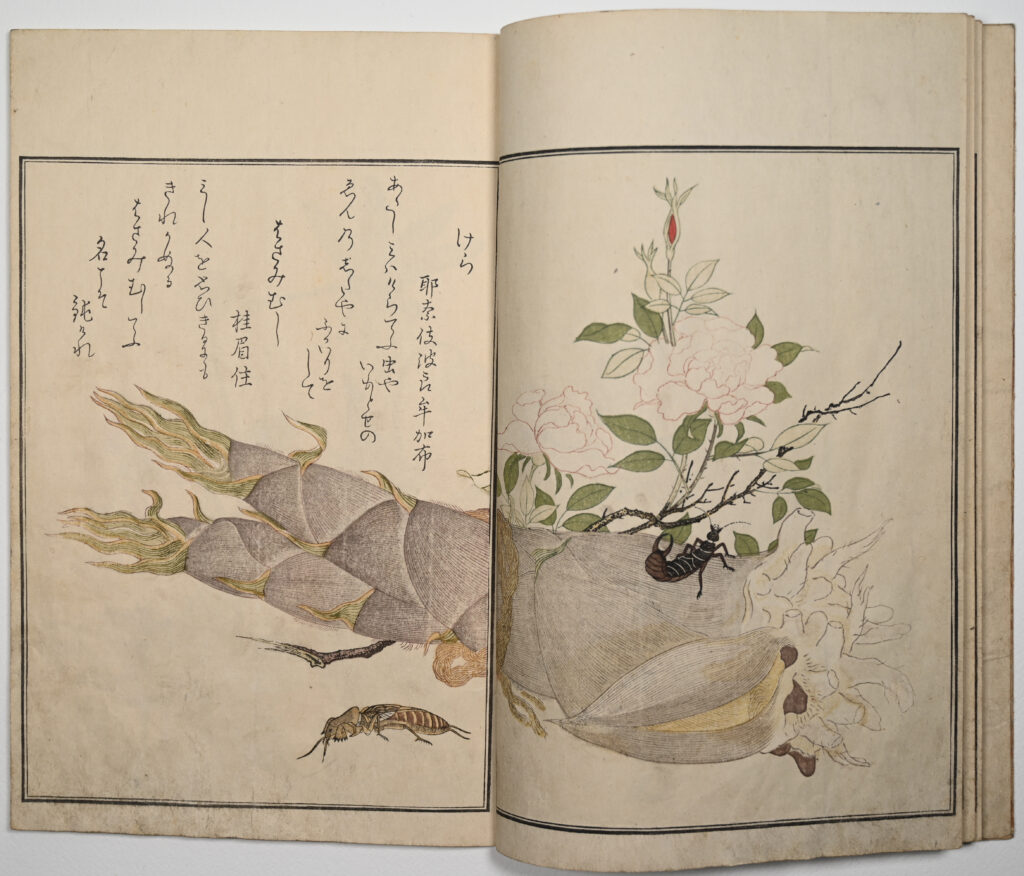
けら
耶奈伎波良牟加布
あたしみはけらてふ虫や
いもとせの
ゑんのしたやに
ふかいりを
して
(Mole Cricket, kera [Order: Orthoptera. Family: Grylloptalpida])
Yanagiwara Mukō
Like the lives of crickets,
male and female
burrowing deep together
beneath the verandah
love lasts but a moment.)
Mole crickets are common insects, but rarely seen because they live in tunnels that they burrow underground. En serves as a pivot word, first as part of imo to se no en, referring to the marital or amorous relationship of a man and woman; then as part of the phrase en no shita, "hidden beneath the verandah." Since en can also refer to the "fate" that allows lovers to meet each other, and that even that does not occur, the poet pessimistically suggests amorous relations are as transient as the life of an insect.
Trans. and comm. by John T. Carpenter
はさみむし
桂眉住
みし人を思ひきるにも
きれかぬる
はさみむしてふ
名こそ
鈍けれ
(Earwig, hasami-mushi [Order: Dermaptera. Family: Forficulidae]
Katsura no Mayuzumi
Though by name
you are the "scissors insect,"
when you try to cut off
ties with a lover of the past
you cannot sever cleanly.
An earwig, with its distinctive pincers protruding from its posterior, is perched atop a bamboo shoot. The poem puns on the literal meaning of hasami-mushi, "scissors insect," suggesting that its blades are ozokere, which means both "dull" (like a pair of scissors) and "insensitive."
Trans. and comm. by John T. Carpenter
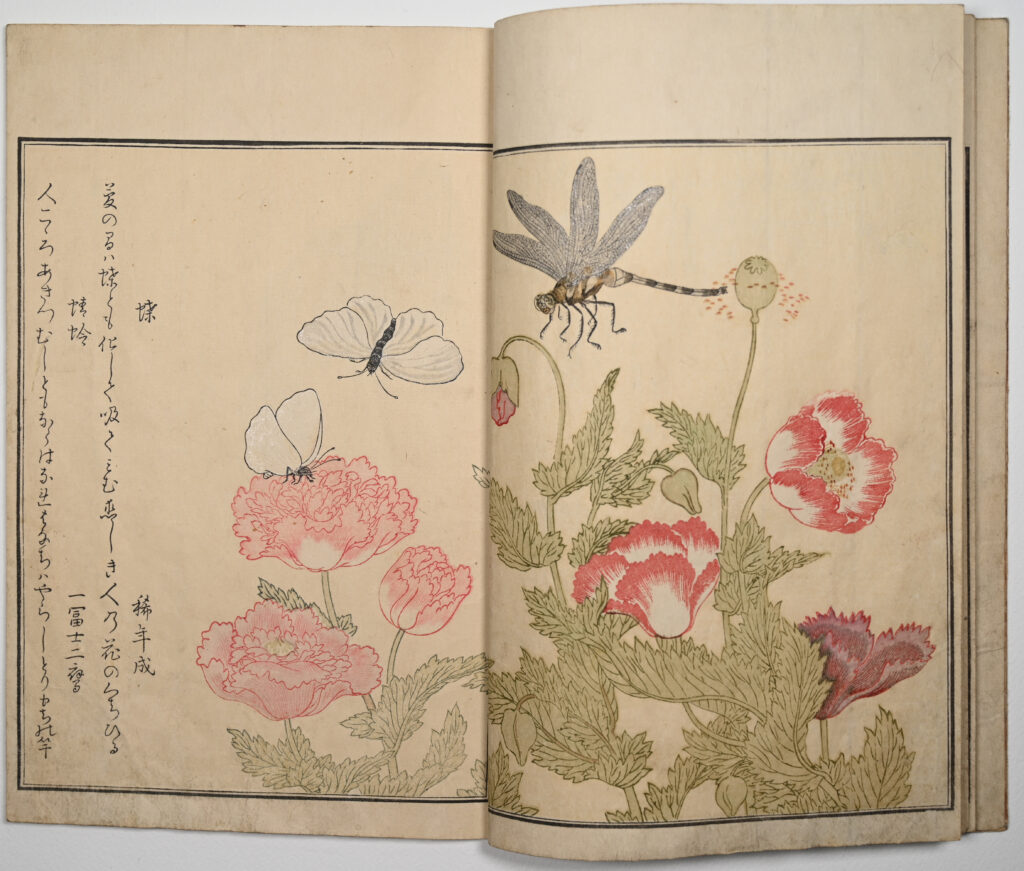
蝶
稀年成
夢の間は蝶とも化して吸てみむ恋しき人の花のくちひる
(Butterfly, chō [Order: Lepidoptera. Family: Perridae]
Marena Toshinari
If while dreaming
I turn into a butterfly,
then I would kiss
the budlike lips
of the one I love.)
A pair of white-winged butterflies, printed with mica, are flitting about a branch of peony (botan) in blossom. The poem alludes to a famous passage from the Chinese philosopher Zhuangzi, reflecting on whether he had a dream in which he was a butterfly, or whether he might be a butterfly dreaming that he was Zhuangzi. The poet here casts aside such existentialist musing to suggest that, whatever the case, he would like to kiss his lover like a butterfly sucks pollen from a flower.
Trans. and comm. by John T. Carpenter
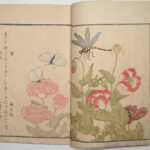
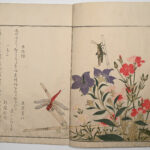
蜻蛉
一冨士二鷹
人こゝろあきつむしともならはなれはなちはやらしとりもちの竿
(Dragonfly, kagerō [or tonbo] [Order: Odonata]
Ichifuji Nitaka
If you no longer love me,
then try to leave, like a dragonfly
that wants to fly away,
yet I won’t let you escape
from my long sticky pole!
A dragonfly, also with wings printed with mica, hovers over an opium poppy (keshi) in various stages of bud and blossom. The opening lines of the poem pivot on aki: first as part of the expression hito kokoro akitsu, "my lover has lost interest in me," and akitsu (or akizu), another name for "dragon fly" in classical Japanese. The characters for kagerō beside the poem can also be pronounced tonbō, the modern word for dragonfly. The poet suggests that if his lover tries to leave him, he will recapture her with a torimochi no sao, a long pole smeared with birdlime (a sticky substance usually made from the bark of holly) used to catch small birds or insects. The poet Ichifuji Nitaka’s name literally means "One Mt Fuji, two hawks," referring to auspicious things one hopes to see in a New Year’s dream.
Trans. and comm. by John T. Carpenter
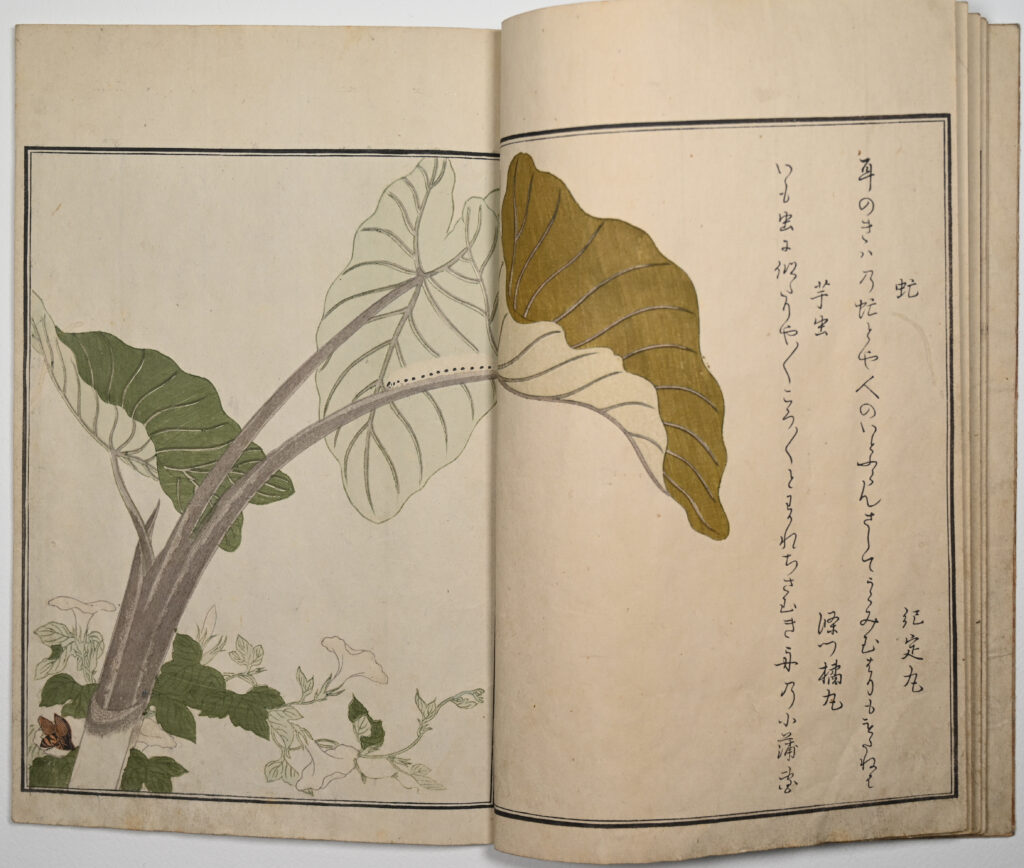
虻
紀定丸
耳のきはの虻とや人のいとふらんさしてうらみむはりもそたねは
(Horsefly, abu [Order: Diptera. Family: Tabanidae]
Ki no Sadamaru
I don’t have a stinger
to make her feel sore,
so she just gets annoyed
with me, like a horsefly,
buzzing by her ear.)
A horsefly rests on the flower of a variety of morning-glory vine. As the poem suggests, a horsefly does not puncture the skin with a stinger, but has serrated mandibles that rip into the flesh. The poet is not only suggesting that he lacks a hari, a stinger (no doubt with double entendre intended), but also hari in the sense of "pride" or "pluck" of a confident lover, allowing the parallel interpretation: "Since I lack the confidence to wreak vengeance on her, she just feels mildly annoyed at me!"
Trans. and comm. by John T. Carpenter
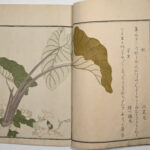
芋虫
深つ橘丸
いも虫に似たりや〳〵ころ〳〵とわかれちさむき舟の小蒲団
(Caterpillar, imo-mushi [Order: Lepidoptera]
Jōmon Kitsumaru
On my way home, alone,
in the cold, on a skiff
swaddled in a padded quilt,
don’t I look just like
a roly-poly caterpillar!)
An embossed caterpillar slinks along the stem of a taro plant (satoimo). The poet relates his experience of heading home alone from an evening with a courtesan in Yoshiwara in a small chokibune, a skiff used by wealthy patrons to travel to and from the pleasure quarters. Since the early morning air is brisk, he has wrapped himself in a small quilt provided by the ferryman, and likens himself to a plump caterpillar.
Trans. and comm. by John T. Carpenter
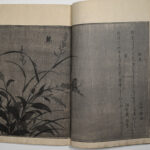
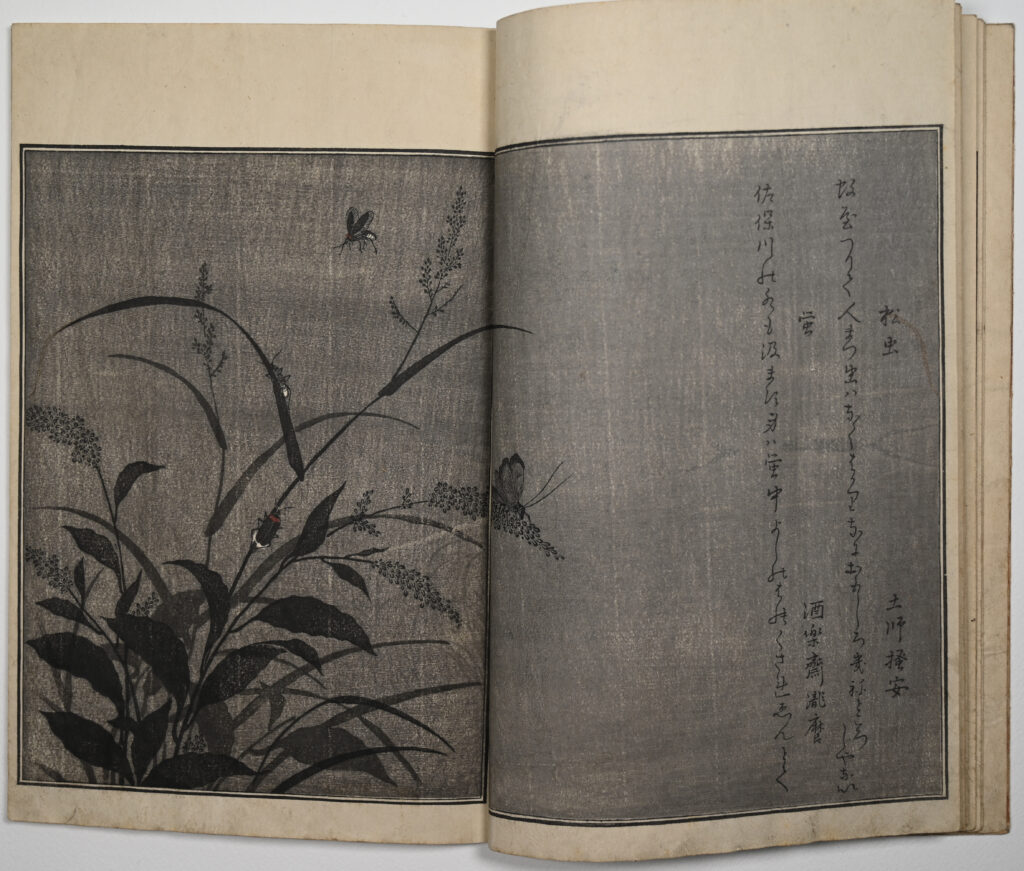
松虫
土師掻安
蚊屋つりて人まつ虫はなくはかりなにおもしろきねところじやない
(Tree Cricket, matsu-mushi [Order: Orthoptera. Family: Gryllidae]
Haji no Kakiyasu
Under a mosquito net,
she awaits her lover–
still sleepless, she weeps,
enduring the monotonous
chirping of a tree cricket.
The verb naku refers both to the "weeping" of the woman awaiting her lover, and to the ‘chirping’ of an insect or bird, suggesting that the sounds of the cricket and sleeping alone are similarly tedious. Only the male cricket chirps, creating the strident but monotonous sound by rubbing its forewings together. The chirping sound is used to attract females or repel male competitors, and the rate varies according to the temperature. The nocturnal setting of the image seems appropriate for this poem, and, of course, the accompanying one on the topic of fireflies. Here the tree cricket climbs on a smartweed plant.
Trans. and comm. by John T. Carpenter
蛍虫
酒楽斎瀧麿
佐保川の水も汲ます身は蛍中よしのはのくされしんして
(Firefly, hotaru [Order: Coleoptera. Family: Lampyridae]
Shurakusai Takimaro
Scooping the water
of the Sao River, I become
a firefly who lives close by,
while leaves of reeds decay,
as does love over time.
The Sao (Saho) River in the Nara area was referred to in classical Japanese verse and traditionally associated with plovers and fireflies. The second half of the poem refers to the premodern Japanese seasonal expression "Decayed grasses turn into fireflies" (fusō hotaru to naru); the word for decay is written with the same character used for kusare in the poem. Kusare-en refers to a love that has deteriorated into a strained, love-hate relationship, but which remains indissoluble. Here the reed depicted appears to be a ditch reed, which grows by river banks and marshy areas.
Trans. and comm. by John T. Carpenter
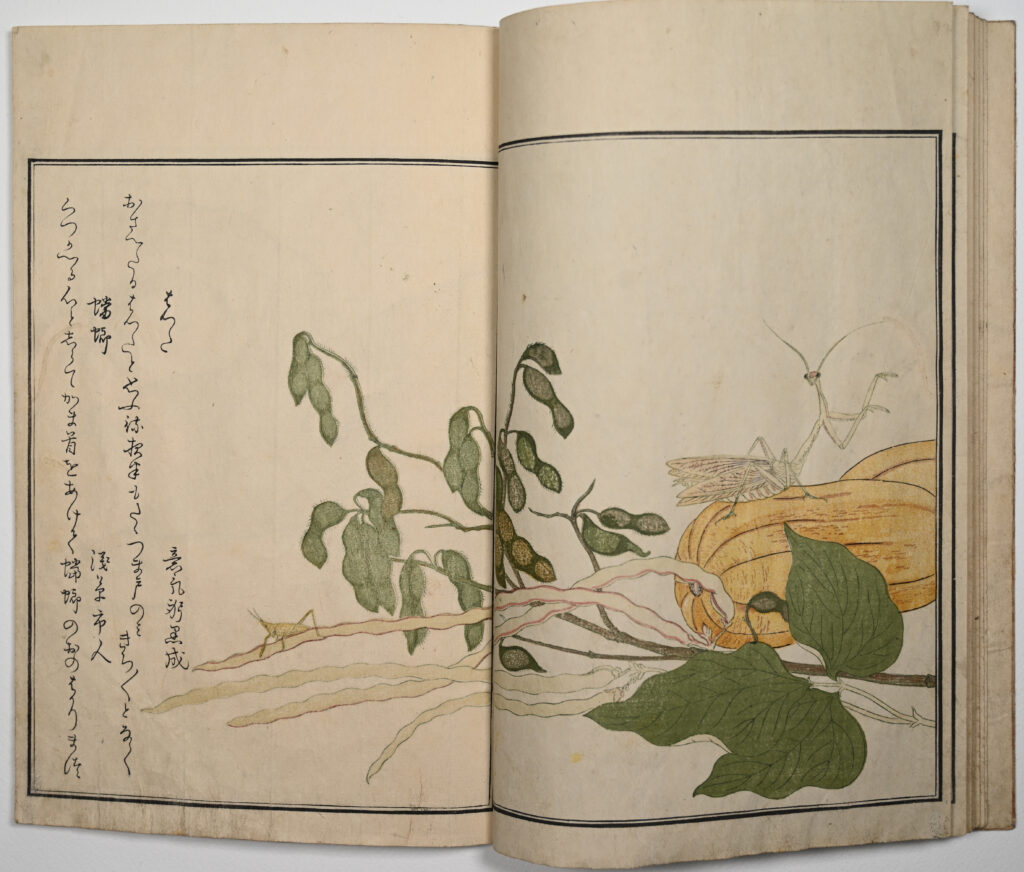
はつた
日意気行黒成
おさへたるはつたと思ふ待夜半もたゝつま戸のみきち
きち〳〵となく
(Locust, batta [Family: Tettigoniidae]
Ikimi Kuronari
As I waited for my lover,
weeping, I thought I heard
the chirping of a trapped locust,
but it was only the creaking
of hinges of a side door.)
The batta locust is crawling on a bean pod, or ingen mame; behind it is a soybean plant (eda mame). The poet puts himself in the mindset of a woman who is waiting for her lover to arrive, and listening for a signal of his arrival. But the only noise she hears is the creaking of a hinged door used as a side entrance (tsumado), which she mistakes for a locust chirping. Gichigichi is onomatopoeic for the creaking of a door, or the chirping of certain insects. The verb naku can variously refer to the sound of "weeping," "chirping" or "creaking."
Trans. and comm. by John T. Carpenter
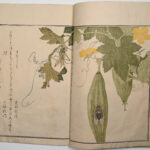
蟷螂
浅草市人
くつかかへる心としらてかま首をあけて蟷螂のおのはかりまつ
(Praying Mantis, tōrō (or kamakiri) [Order: Orthoptera. Family: Matidae]
Asakusa no Ichindo
Ignoring whether or not
you’ve had a change of heart,
I’ll wait, even if to no avail,
like the mantis that stretches
its neck out and "wields an axe."
Tōrō no ono, "axe of the praying mantis," is a colloquial expression suggesting that an action is futile, like waiting for a former lover who is no longer interested. Here the mantis raising its head (as suggested by the poem) is perched on a type of muskmelon. The poet Asakusa no Ichindo (1755–1820), a pawnbroker in the Asakusa district of Edo, was on close terms with many of the pioneers of the Tenmei kyōka society. He founded the Asakusa poetry circle (also known as the Tsubo-gawa, or "Jug poetry group," derived from the shape of its emblem).
Trans. and comm. by John T. Carpenter
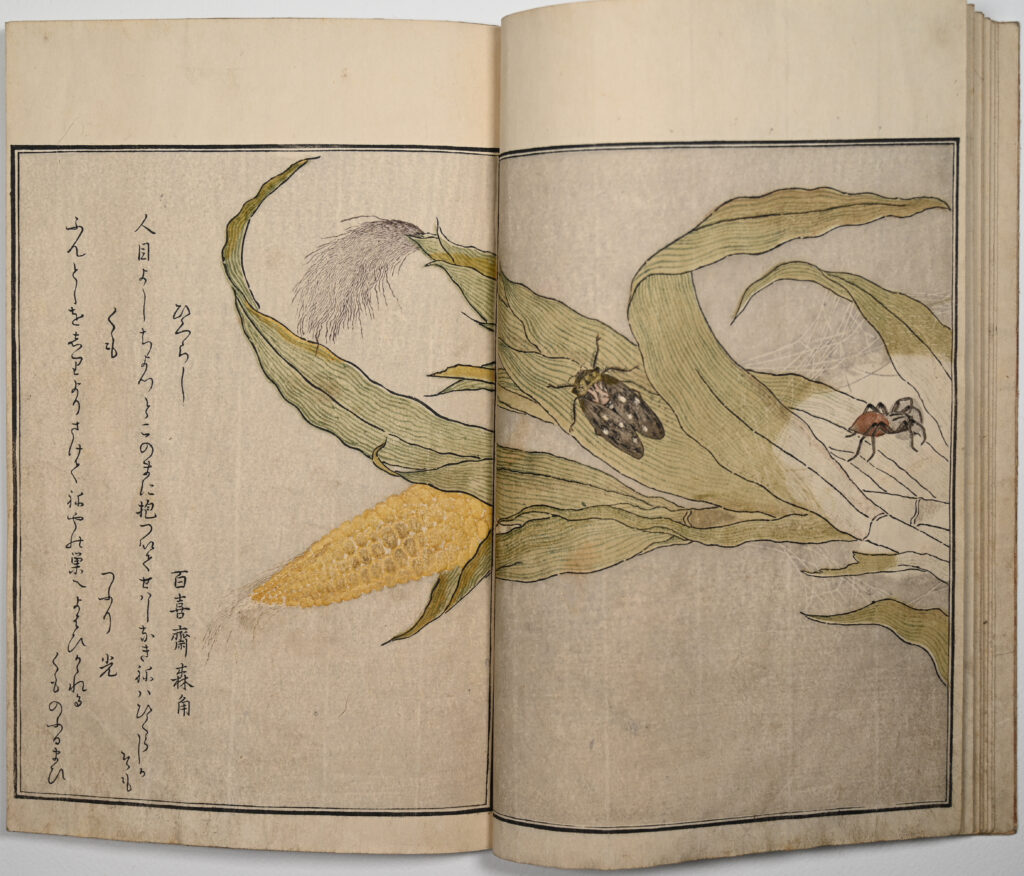
ひくらし
百喜斎森角
人目よしちよつとこのまに抱ついてせはしなきねはひくら
しか
そも
(Evening Cicada, higurashi [Order: Homoptera. Family: Cicadidae]
Hyakkisai Morikado
When no one is watching,
I fly into your arms,
and then we hurriedly
sleep together in silence,
as a cicada cries at sunset.
The poem opens with the image of lovers who have to find opportunities for a secret rendezvous, and who must suffer silently. The word naki-ne can mean"‘weep in one’s sleep" in the sense of having to bear a situation in silence, but also means "the sound of chirping" as of a cicada.
Trans. and comm. by John T. Carpenter
くも
つふり光
ふんとしをしりよりさけてねやの巣へよはひかゝれる
くものふるまひ
(Spider, kumo [Class: Arachnida]
Tsumuri no Hikaru (Kishi Bunshō)
As if a loincloth
dangles from his rear,
he crawls towards the nest
where his lover sleeps––
the movements of a spider!
The poet likens a spider spinning its web, emitting strands of silk from its posterior, to a man with his loincloth already unknotted, furtively entering a woman’s bed- room. Since ancient times the poetic phrase kumo no furumai, "movements of a spider"––referring to a spider weaving its web or crawling over one’s clothes––was said to be an omen of the imminent arrival of an acquaintance, spouse or male lover. Here the spider is spinning a cobweb between the leaves of an ear of corn. The poet Tsumuri (or Tsuburi) no Hikaru (1754–96) was a local administrator in the Nihonbashi Kameichō district who worked for a while as a book illustrator after studying under the ukiyo-e master Ippitsusai Bunchō. As one of the most prominent kyōka poets of the day, Tsumuri was active with Kubo Shunman in the Hakuraku poetry circle.
Trans. and comm. by John T. Carpenter
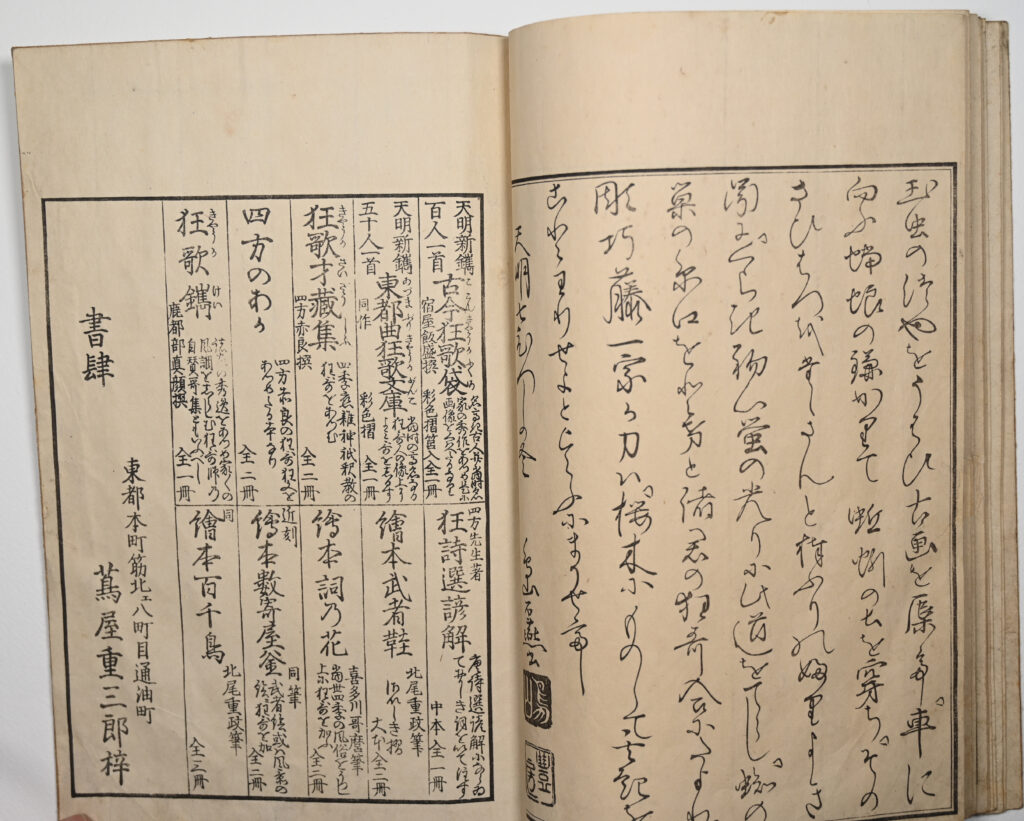
玉虫のつやをうはひ古画を廩て車に 向ふ城娘の鎌かりて蚯蚓の土を穿ち。その さひはつをたゝさんとつふりのふりよき 湯にくらき初山蛍の光りに此道をてらし蜘の 巣の糸口をとけと諸君の狂哥入口にたよれ 彫巧藤一宗か刀は。桜木にものして其観を ことわりせよとこらふにまかせてし 天明七ひつしの冬 鳥山百燕公 わしの 同二〇円{
Unverified OCR ; verify against the image before use.
書肆
東都本町筋北エ八町目通油町
蔦屋重三郎梓
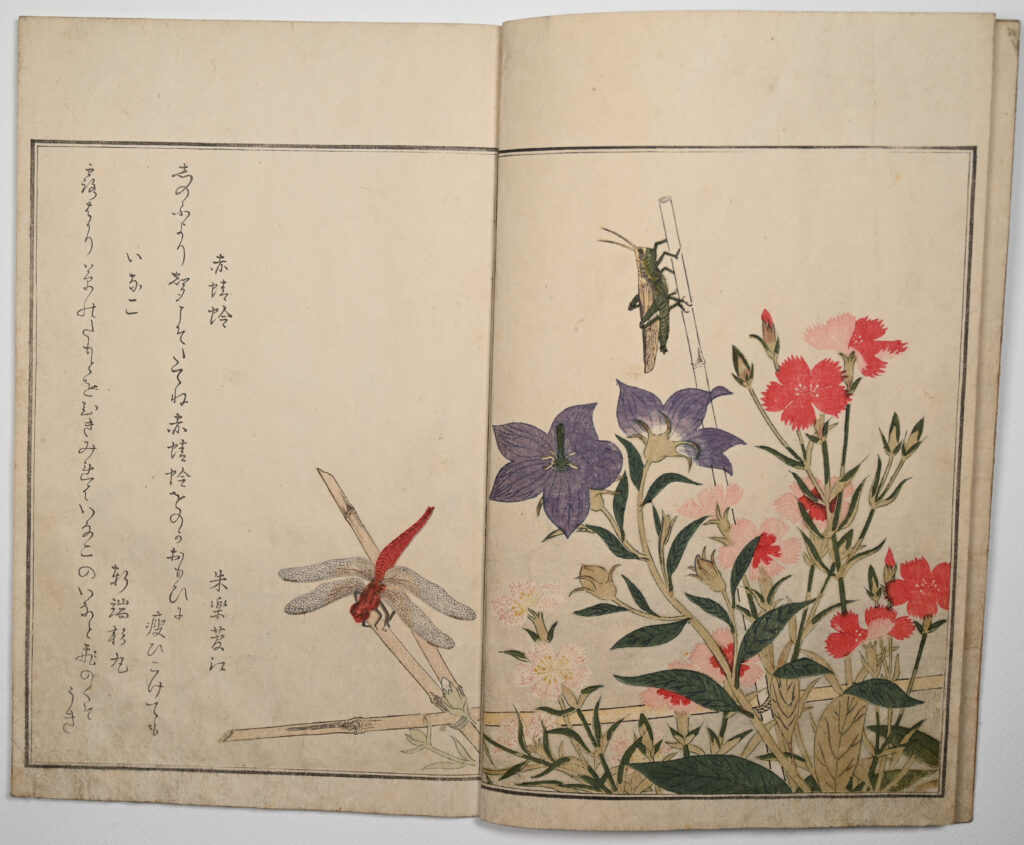
赤蜻蛉
朱楽菅江
しのふより声こそたてね赤蜻蛉をのかおもひに
痩ひこけても
軒端杉丸
露はかり草のたもとをひきみれはいなこのいなと飛のくそ
うき
Unverified OCR ; verify against the image before use.
いなこ
Unverified OCR ; verify against the image before use.
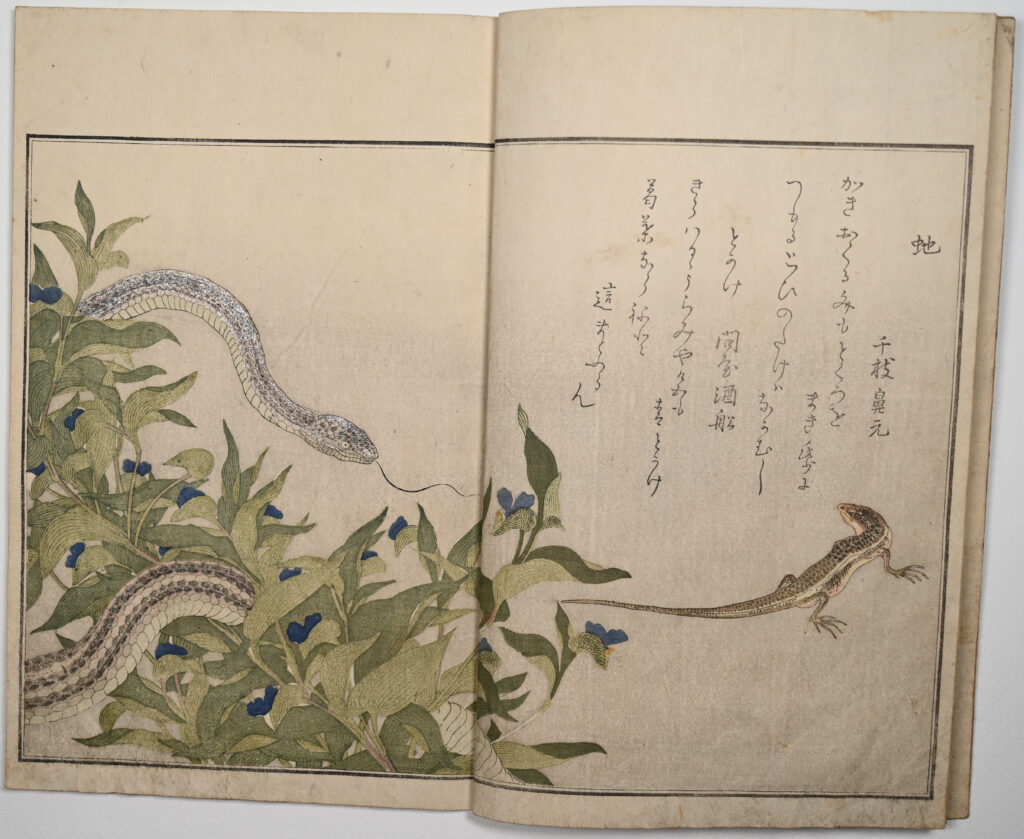
地
Unverified OCR ; verify against the image before use.
千枝鼻元
かきおくるみもとくろを
まきの姿に
つもるとひのたけは
なかむし
とかけ問屋酒船
きらはるゝうらみや色も
葛葉ならねと
青とかけ
這まとふる
Unverified OCR ; verify against the image before use.
□
□
Unverified OCR ; verify against the image before use.
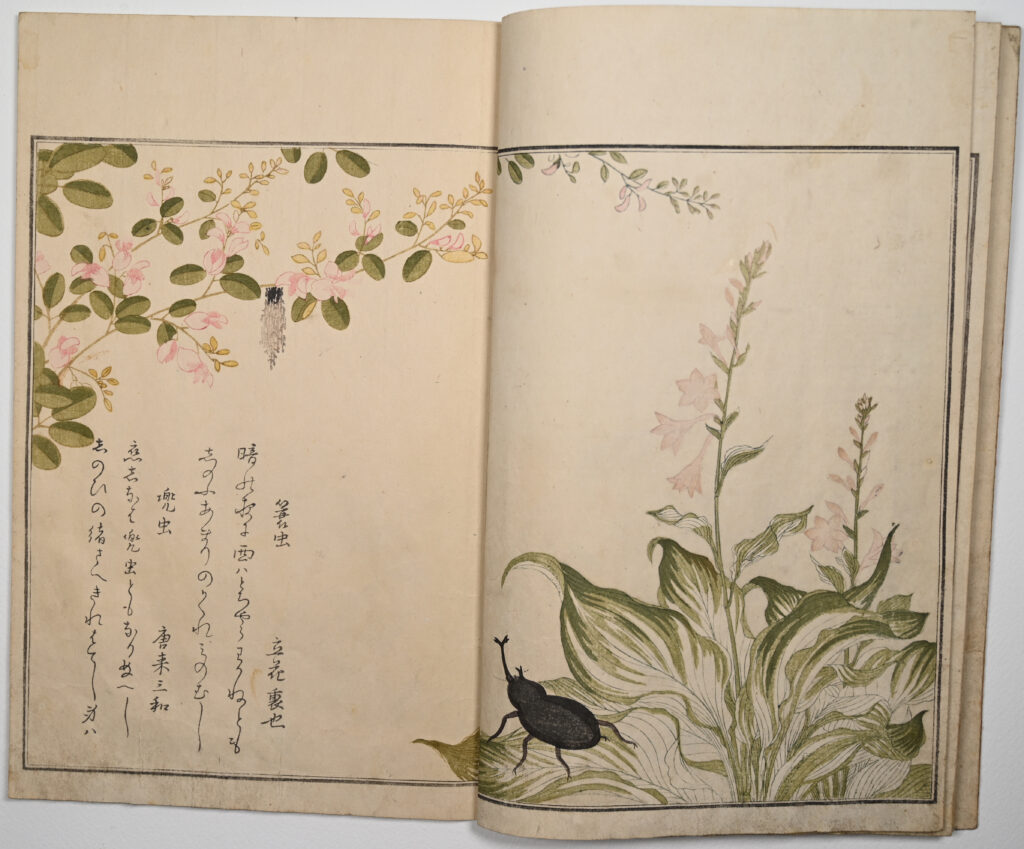
蓑虫
立花裏也
晴の夜に西はとちやらわかねとも
しのふあまりのかくれみのむし
兜虫
唐来三和
恋しなは兜虫ともなりぬへし
しのひの緒さへきれはとし身は
Unverified OCR ; verify against the image before use.
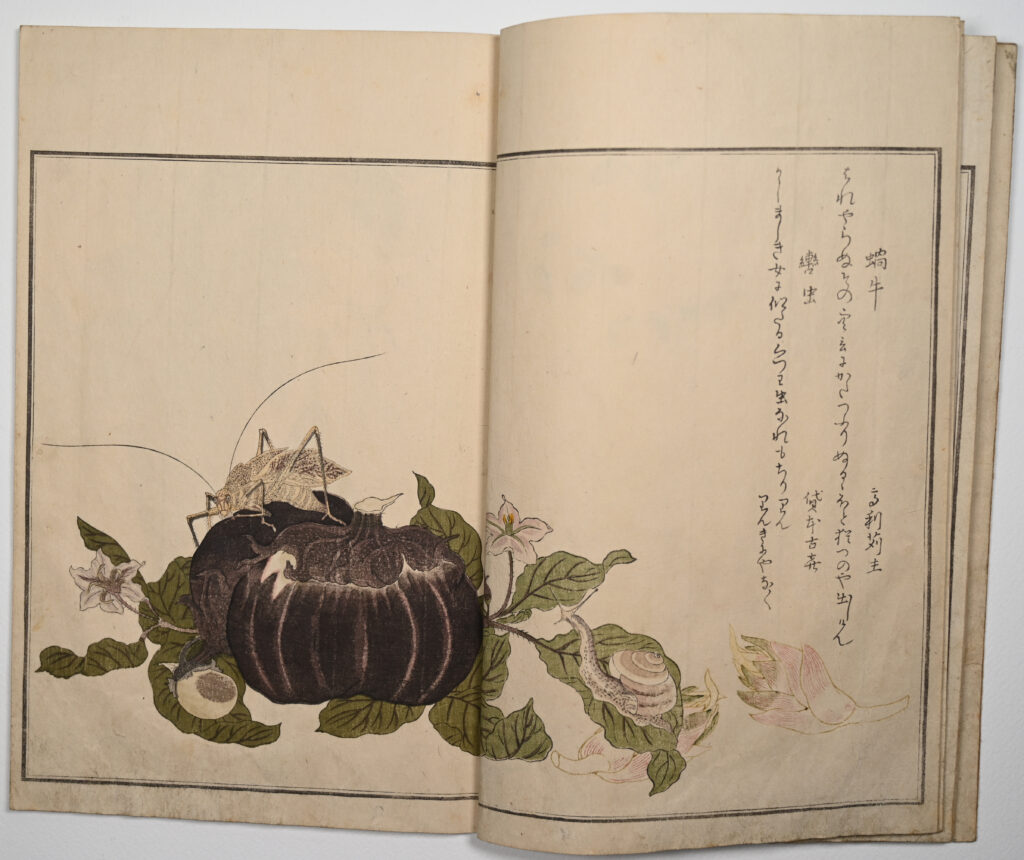
蝸牛
高利苅生
はれやらぬその空言にかたつふりぬるゝほと猶つのや出しけん
轡虫
貸本古喜
かしましき女に似たるくつわ虫なれもちりん
りんきにやなく
Unverified OCR ; verify against the image before use.
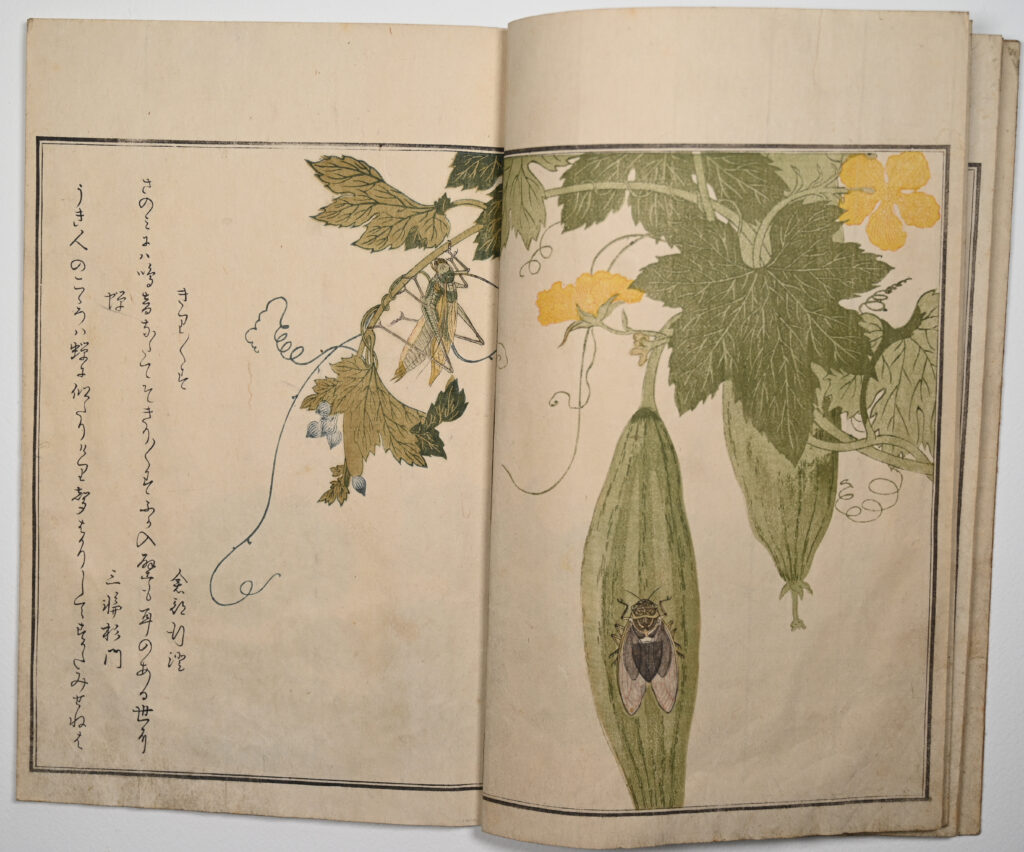
きり〳〵す
Unverified OCR ; verify against the image before use.
一倉部行澄
さのみには鳴音なたてそきり〳〵すふか入圧も耳のある世に
蝉
三輪杉門
うき人のこゝろは蝉に似たりけり声はかりしてすかたみせねは
Unverified OCR ; verify against the image before use.
かな
十七
Unverified OCR ; verify against the image before use.
堺
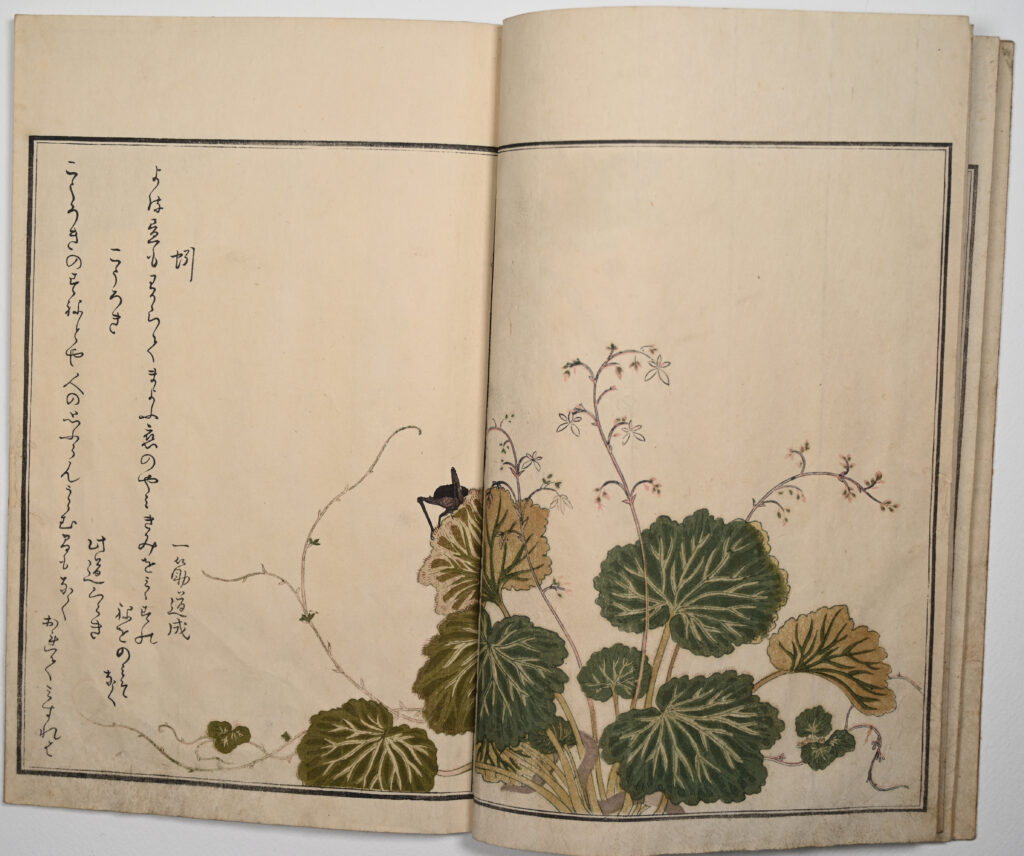
一筋道成
よる昼もわからてまよふ恋のやみきみをみゝすの
こうろき
ねをのみそ
此道くらき
なく
こうろきのすねとや人の思ふらんうらむ間もなく
おれてみすれは
Unverified OCR ; verify against the image before use.
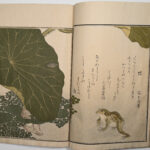
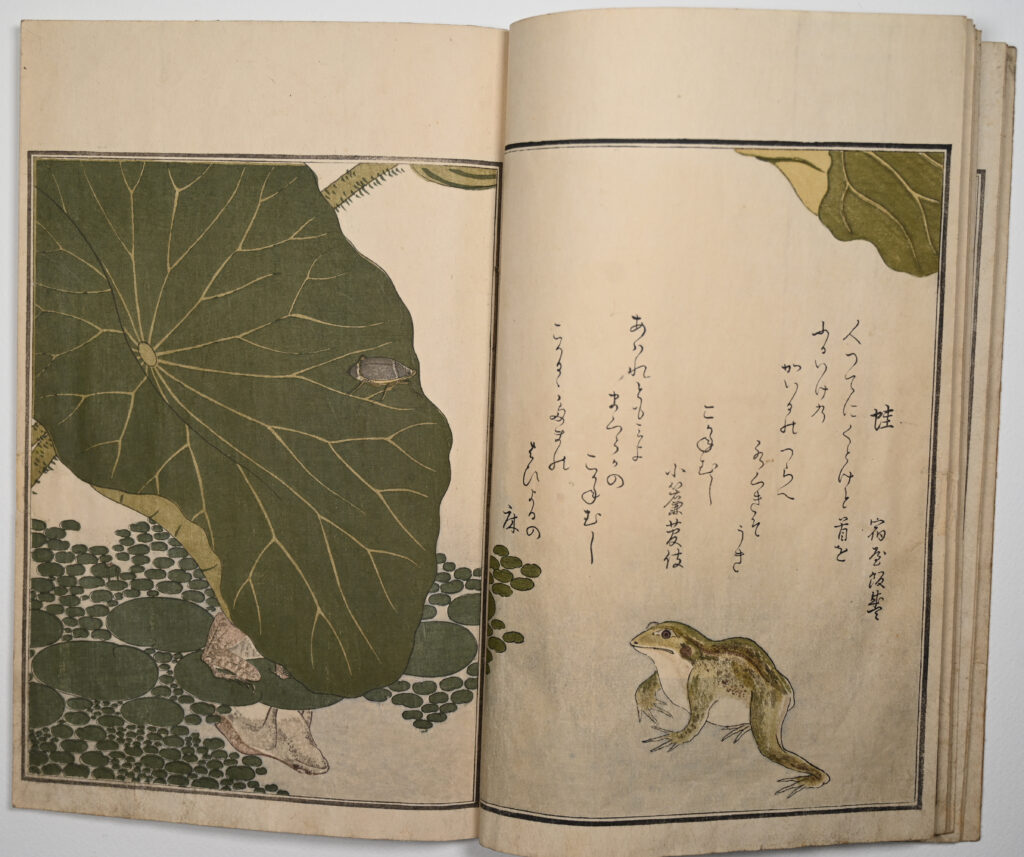
蛙
宿屋飯盛
人つてにくとけと首を
ふるいけの
かいるのつらへ
水くきそ
うさ
Unverified OCR ; verify against the image before use.
こかねむし
小簾菅伎
Unverified OCR ; verify against the image before use.
あはれともみよ
まくらかの
こかねむし
Unverified OCR ; verify against the image before use.
こかるゝたまの
はひよるの
床
Unverified OCR ; verify against the image before use.
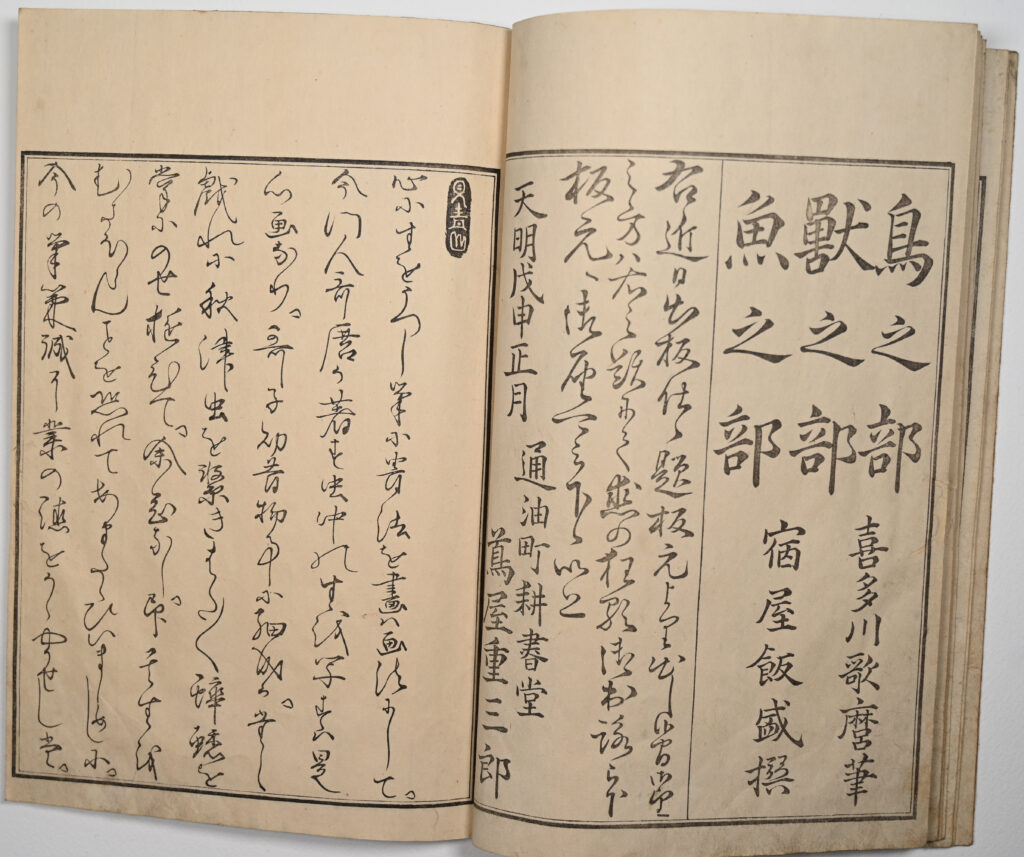
鳥之部
喜多川歌麿筆
獣之部
宿屋飯盛極
魚之
一
右近日出板仕候題板元より出し候間御座候
之方ハ右之趣にて懇の狂類御出路被下
板元へ御届可被下候以上
天明戊申正月
通油町耕書堂
蔦屋重三郎
Unverified OCR ; verify against the image before use.
●八十五日
心にすをうつし筆に寄法を画は画法にして
今門人哥唐か著す虫中の生を写すは是
心画なり、哥子幼昔物事に細成る、たし
戯れに秋津虫を繋きはた〳〵辞恋を
掌にのせ遊ひて。余ひなし。予其生を
むさほらんことを恐れてあまたらひいましめしに。
今の筆策誠に業の鎮をかしやかせしは
Unverified OCR ; verify against the image before use.