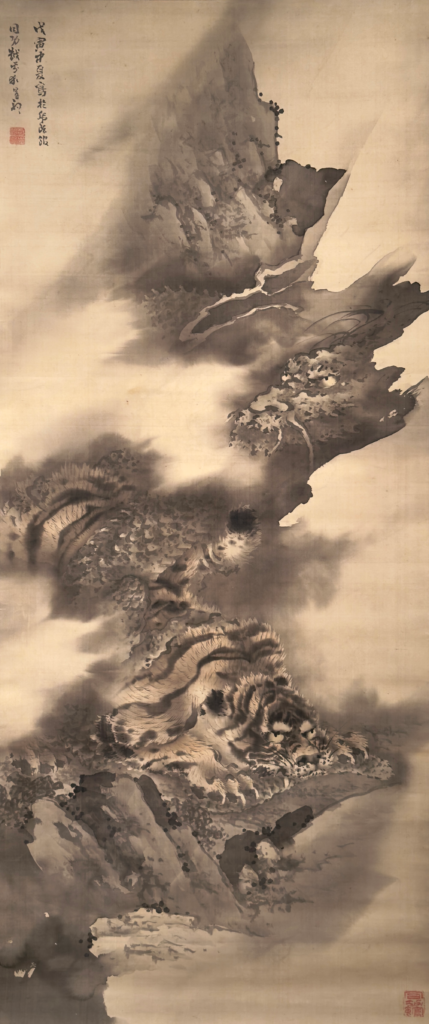
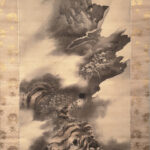
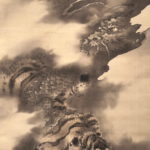
Dragon and tiger are archetypal rivals, embodiments of terrestrial and celestial force. While they are often depicted confronting one another from a distance, here they are locked in fierce, close-quarters combat. The tiger, crouched low against the rocks, lunges forward to bite the dragon’s tail, even as that same scaled tail coils tightly around its body. Through drifting mist created by layered ink washes, the viewer perceives only fragments of their forms and the surrounding landscape, yet the defining features of their formidable power emerge. This selective revelation heightens the sense of intensity and imaginative mystery within the frame and demonstrates the artist’s masterful control of ink and water on the silk surface.
Gan Ku, a prominent Kyoto artist and founder of the Kishi school, was renowned for his tiger paintings. Here, he signs himself with an unusual fullness of titles, including his honorary official post, suggesting that the work was a special commission for a distinguished patron. Among these titles is Kotōkan, meaning “Tiger-Head Studio,” a name he began using in 1799 after acquiring a specimen consisting of a tiger’s head and four paws from a Chinese merchant. Although it is difficult to argue that this acquisition alone transformed his approach from the earlier convention of round-faced, catlike tigers derived from pictorial models, it reflects his pursuit of direct observation as well as access to rare materials that accompanied his rising status. The convincing anatomical structure and tense musculature of the tiger seen here exemplify this shift in his later career.
Dragon and tiger are archetypal rivals, embodiments of terrestrial and celestial force. While they are often depicted confronting one another from a distance, here they are locked in fierce, close-quarters combat. The tiger, crouched low against the rocks, lunges forward to bite the dragon’s tail, even as that same scaled tail coils tightly around its body. Through drifting mist created by layered ink washes, the viewer perceives only fragments of their forms and the surrounding landscape, yet the defining features of their formidable power emerge. This selective revelation heightens the sense of intensity and imaginative mystery within the frame and demonstrates the artist’s masterful control of ink and water on the silk surface.
Gan Ku, a prominent Kyoto artist and founder of the Kishi school, was renowned for his tiger paintings. Here, he signs himself with an unusual fullness of titles, including his honorary official post, suggesting that the work was a special commission for a distinguished patron. Among these titles is Kotōkan, meaning “Tiger-Head Studio,” a name he began using in 1799 after acquiring a specimen consisting of a tiger’s head and four paws from a Chinese merchant. Although it is difficult to argue that this acquisition alone transformed his approach from the earlier convention of round-faced, catlike tigers derived from pictorial models, it reflects his pursuit of direct observation as well as access to rare materials that accompanied his rising status. The convincing anatomical structure and tense musculature of the tiger seen here exemplify this shift in his later career.
Title:
Dragon and Tiger in Divine Combat
Additional Titles:
Creator:
Date:
Period:
Culture:
Medium:
Dimensions:
Classification:
Inscriptions, Signatures, and Seals:
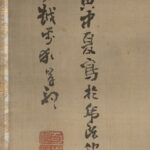
Signature: Boin chūka, Kotōkan [ni] oi[te] Dōkō, Echizen no Suke, Gan Ku sha[su] 戊寅中夏寫於乕頭館同功越前介岸駒 (In the mid-summer of boin cyclical year [Fifth month of 1818], at the Tiger Head Studio, Dōkō, Assistant Governor of Echizen Province, Gan Ku painted this.)
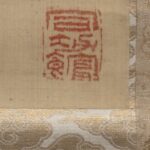
Seal:(below signature, square intaglio seal, decided into two registers) Kakan 可觀; Gan Ku 岸駒; (lower right corner, rectangular relief seal) 同功館 Dōkōkan;
Box Inscription: Ryūkotō jintsū zu 竜乕鬪神通圗 (Painting of the Miraculous Struggle of the Dragon and Tiger);
Verso of the box lid: Kono fuku senjin Tenkai-ō no sho ga/ Kenpon chokutei/ Meiji nijūshichi-nen kōgo natsu gogatsu/ Kishi Chikudō kan 此幅先人天開翁之所画/ 絹本直幀/ 明治廿七年甲午夏五月/岸竹堂觀 (This painting, was painted by my ancestor Tenkai-ō [Gan Ku], on silk, plain mounting. Fifth month of summer, Meiji 27, kōgo cyclical year [1894]. Viewed by Kishi Chikudō.) (below signature, a square intaglio seal) Shōroku 昌禄; (a square relief seal) Shiwa 子和.