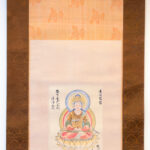
法波羅密菩薩 金胎仏画帖模本
Dharma-pāramitā Bodhisattva, copy from Album of Buddhist Deities from the Diamond World and Womb World Mandalas
Unidentified artist
Mid-20th century
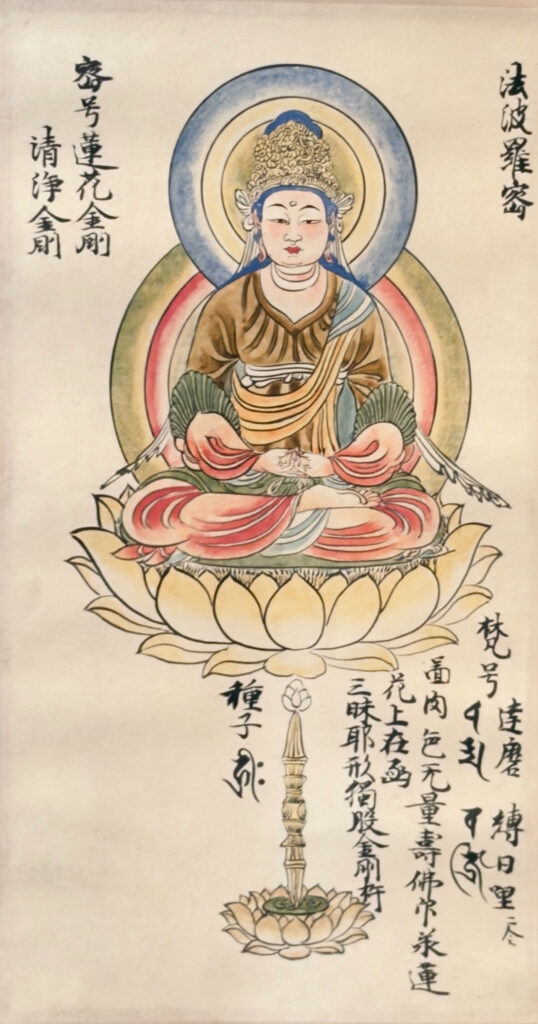
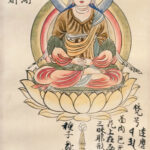
Seated on a lotus pedestal, Dharma-pāramitā Bodhisattva holds her hands in the meditation mudra, symbolizing the focused purity and perfection of the Buddhist Law. Beneath her stands a single-pronged vajra, her samaya (spiritual symbol). As an attendant to Vairocana Buddha in the western quarter of the Diamond Realm, she and her attributes appear visually above the central Vairocana in the mandala layout. The surrounding inscriptions provide a comprehensive iconographic record, detailing her common and esoteric names, the pronunciation of her Sanskrit name alongside its Siddham script, and a textual description of her form and seed syllable.
This is a copy of a leaf from the Album of Buddhist Deities of the Diamond and Womb Realms, a twelfth-century visual compendium based on the Diamond Peak Sūtra, a foundational scripture of Esoteric Buddhism. The album serves as a detailed guide to the complex iconography of the deities and their positions within the mandala. Unlike more common monochromatic iconographic drawings, this album was vividly colored, suggesting that it was produced under elite patronage. Originally containing more than one hundred leaves, the album was preserved at Ganjōji Temple in Kumamoto until around 1928, when it was dismantled and its leaves dispersed among various public and private collections.
Seated on a lotus pedestal, Dharma-pāramitā Bodhisattva holds her hands in the meditation mudra, symbolizing the focused purity and perfection of the Buddhist Law. Beneath her stands a single-pronged vajra, her samaya (spiritual symbol). As an attendant to Vairocana Buddha in the western quarter of the Diamond Realm, she and her attributes appear visually above the central Vairocana in the mandala layout. The surrounding inscriptions provide a comprehensive iconographic record, detailing her common and esoteric names, the pronunciation of her Sanskrit name alongside its Siddham script, and a textual description of her form and seed syllable.
This is a copy of a leaf from the Album of Buddhist Deities of the Diamond and Womb Realms, a twelfth-century visual compendium based on the Diamond Peak Sūtra, a foundational scripture of Esoteric Buddhism. The album serves as a detailed guide to the complex iconography of the deities and their positions within the mandala. Unlike more common monochromatic iconographic drawings, this album was vividly colored, suggesting that it was produced under elite patronage. Originally containing more than one hundred leaves, the album was preserved at Ganjōji Temple in Kumamoto until around 1928, when it was dismantled and its leaves dispersed among various public and private collections.
Title:
Dharma-pāramitā Bodhisattva, copy from Album of Buddhist Deities from the Diamond World and Womb World Mandalas
Additional Titles:
Creator:
Date:
Period:
Culture:
Medium:
Dimensions:
Classification:
Categories:
Inscriptions, Signatures, and Seals:
Inscriptions: (Upper right) Hō Haramitsu 法波羅密 (Dharma-pāramitā)
(Upper left) Mitsugō 密号(esoteric name) Rene Kongō 蓮花金剛 (The Lotus Vajra) Seijō Kongō 清淨金剛 (purity Vajra)
(Lower right) Bongō 梵号 (Sanskrit name) Daruma Bajri 達摩 縛日哩*二合(Dharma-vajrī)
*二合: Indicates that the preceding and following characters are to be combined and pronounced as a single compound phonetic unit.
dha rma va jri 𑖠𑖨𑖿𑖦𑖪𑖕𑖿𑖨𑖰
Men nikushoku Muryōju-butsu, in jō renge jō zai kan 面肉色無量壽佛印承蓮花上在函 (Flesh-colored face. Muryōju-butsu forms the mudra of Amitābha Buddha and sits upon a lotus that supports a sutra chest.)
Sanmaya-gyō dokko kongōsho 三昧耶形獨股金剛杵 ([Her] samaya form is a single-pronged vajra.)
(Lower left) Shushi hrīḥ 種子 𑖮𑖿𑖨𑖱𑖾
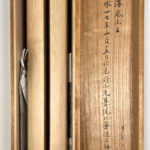
Box inscription: Mikkyō zuzō Hō Haramitsu 密教圖像 法波羅密(Esoteric Buddhist iconography: Dharma-pāramitā) Verso of box lid:Hon zuzō kanmatsu ni iwaku, Ōei nijūshichi-nen shōgatsu jūgo-nichi, Kōyasan Kōdai-in hokuryō ni oite juyo tamau Kōshin; Naniwa Hōgen Kaidō shirusu 本図像巻末云 應永廿七年正月十五日於高野山光臺院北寮授与賜弘真 浪華法眼塊堂識 (On the end of the iconographic handscroll states: “On the fifteenth day of the first month of Ōei 27 [1420], at the North Quarters of Kōdai-in on Mount Kōya, this was bestowed and transmitted to Kōshin.” Inscribed by [Tanaka] Kaidō of Naniwa, holder of the rank of Hōgen.) (Two square seals below the signature)
Provenance:
Exhibition History:
Art Institute of Chicago. Japanese Art from the Alsdorf Collection, Gallery 273, July 2–September 12, 2004.
Morikami Museum and Japanese Gardens. October 3–December 31, 2006.