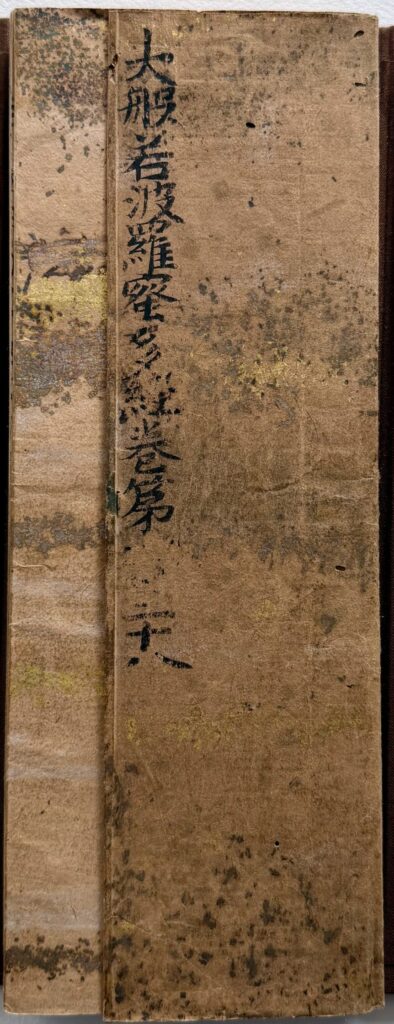
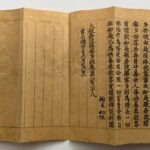
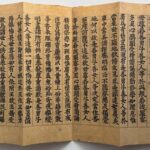
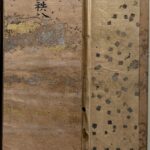
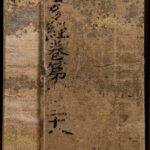
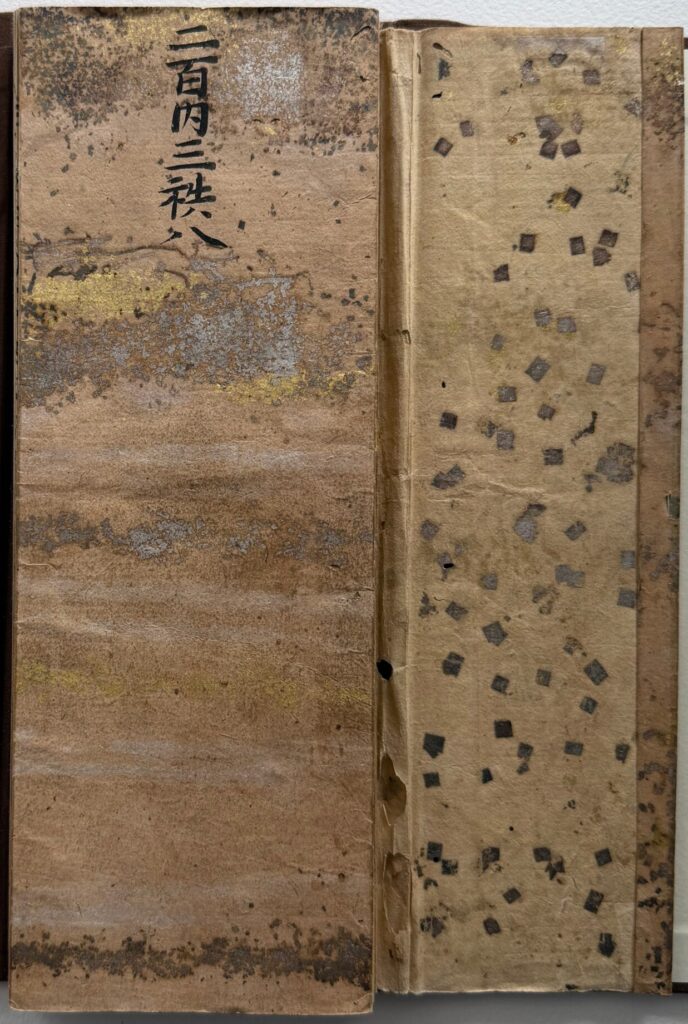
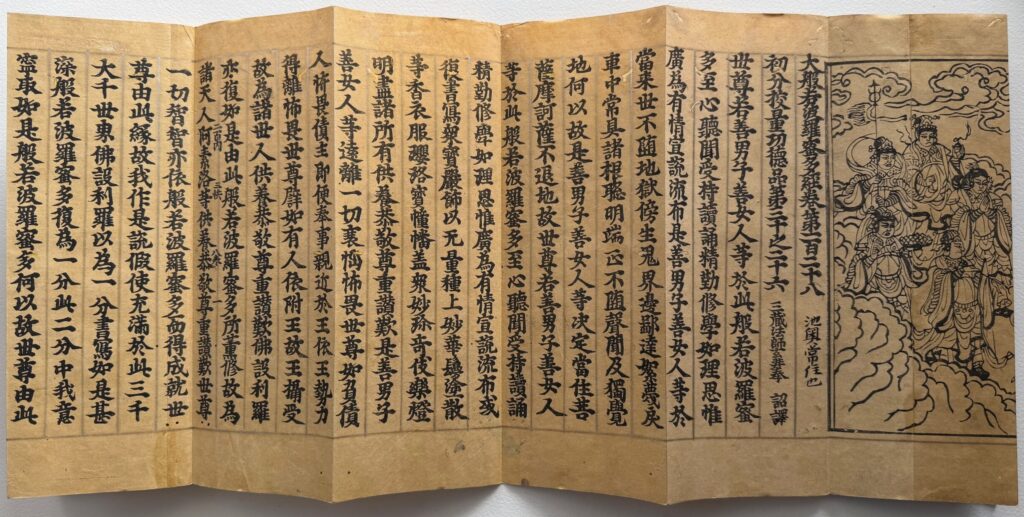
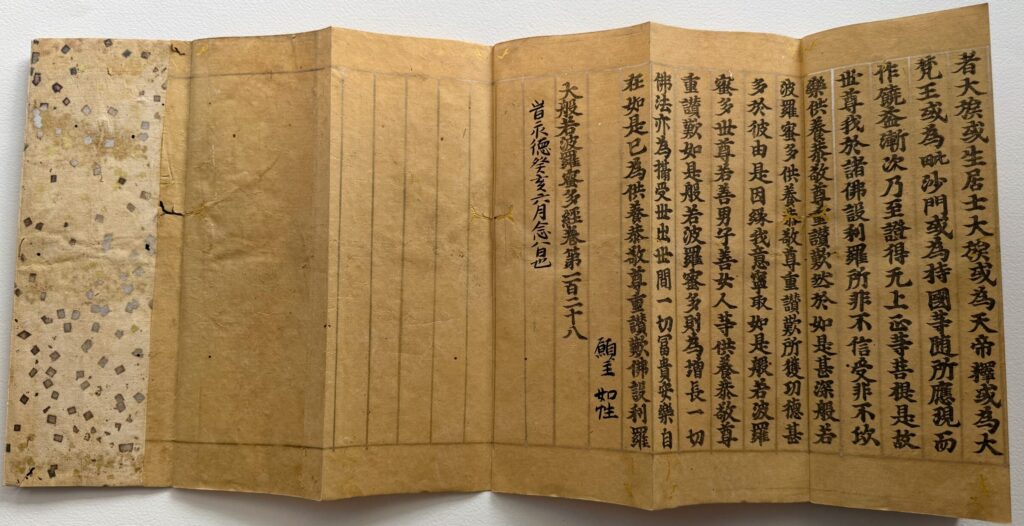
This is a chapter from the Great Perfection of Wisdom Sutra, a foundational scripture of Mahayana Buddhism. The text is woodblock printed, framed throughout by silver ruling lines, and enclosed in lavishly decorated covers. Added hand inscriptions indicate that it formed part of a commissioned set made for Daijōji Temple in present-day Hyōgo Prefecture (also known as “Ōkyo-dera”, later renowned for fusuma paintings by Maruyama Ōkyo.) Although Daijōji once held a complete set of the sutra, more than a hundred volumes are still preserved there, while others are now dispersed among public collections.
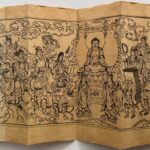
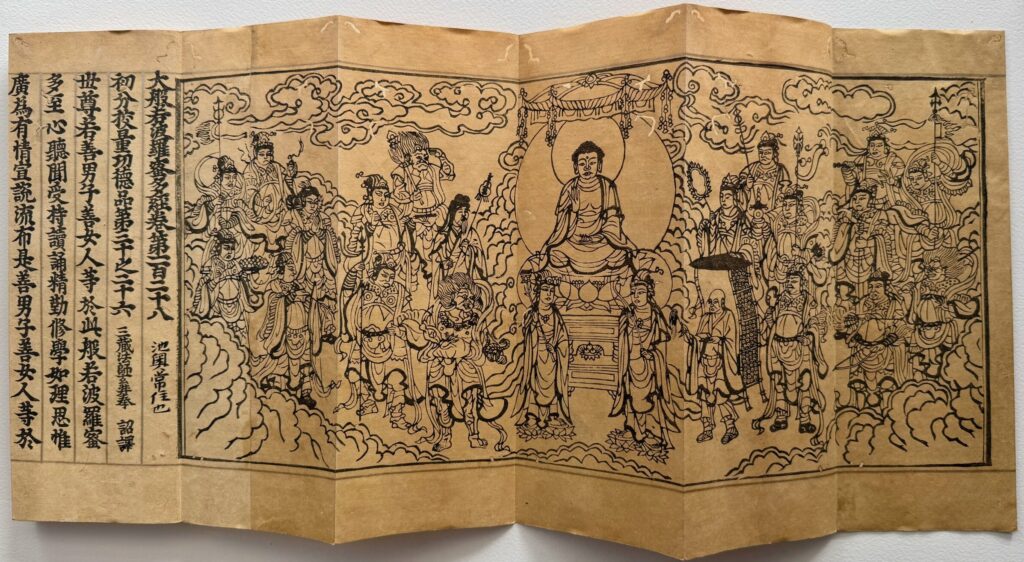
The frontispiece is the earliest known printed illustration in Japan. At its center sits Sakyamuni Buddha, flanked by two attendant bodhisattvas. Surrounding them are the Sixteen Protective Deities, guardians of the sutra and its reciters, together with Kudokuten (Srimahadevi) and Basusen (Vasu). Xuanzang, the Tang-dynasty monk who traveled to India and translated the sutra into Chinese, is depicted standing to the right of a bodhisattva and carrying scrolls of scripture on his back. Opposite him is Jinja Daishō, the General of the Deep Sands, shown with skulls around his neck and traditionally believed to have protected Xuanzang during his journey through the desert.
Title:
Vol. 128 of Daihannya haramitta kyō
Additional Titles:
Creator:
Date:
Period:
Culture:
Description:
Medium:
Binding:
Dimensions:
Classification:
Object Number:
Permalink:
Categories:
Inscriptions, Signatures, and Seals:
Decorated upper cover page: Dai-hannya-harmitta-kyō kan dai hyaku-nijyu-hachi 大般若波羅蜜多經卷第[一百]二十八 (The Great Perfection of Wisdom Sutra, vol. 128);
Decorated lower cover page: Ni-hyaku [no] uchi san-chitsu-hachi 二百內三秩[帙]八;
On the opening of the text block, below the title: Ikeoku jōjū nari 池奧常住;
On the ending of the text block: (lower right corner of the title) Ganshu Nyoze 願主 如性 (Patron Nyoze); (on the left left of the title) Toki Eitoku kigai roku-gatsu nen-hachi-nichi nari 旹永徳癸亥六月念八日也 (on the 28th day of the 8th month of the kigai cyclical year of the Eitoku era [1383])
Provenance:
Other Editions:
Tokyo University of Arts 東京芸術大学 [vol. 150]
Metropolitan Museum of Art [vol. 157]
National Diet Library 国立国会図書館 [vol. 345], [vol. 363]
Nara National Museum 奈良国立博物館 [vol. 365], [vol. 399]
Tokyo National Museum 東京国立博物館 [vol. 377]
National Institute of Japanese Literature 国文学研究資料館 [vol. 459]
Kameisan Daijōji 亀居山大乗寺 [128 vols.]