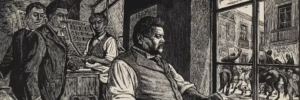
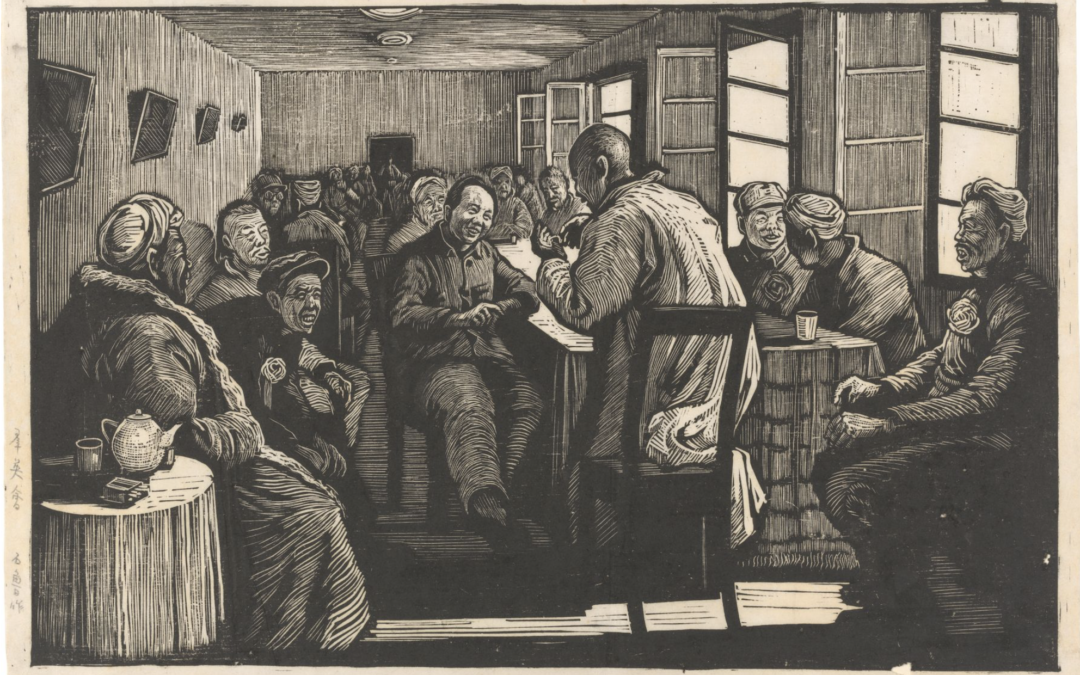
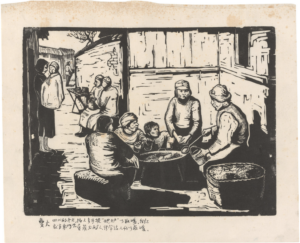
Shi Lu (1919–1982), Gathering of Heroes, ca. 1938-1949.
The Pinkowitz Collection has recently acquired two groups of woodblock prints by the Chinese artists Shi Lu (1919–1982) and Wang Shuyi (1917–1999). Formerly in the collection of Peter Townsend (1919–2006), these works were acquired during Asia Week New York.
Born Feng Yaheng in Renshou, Sichuan, Shi Lu grew up in a prosperous gentry household shaped by classical learning and enriched by family collections of books and art. At the age of fifteen, he enrolled at the newly established Oriental Art College (Dongfang Meishu Zhuanke Xuexiao) in Chengdu, where he studied traditional ink painting while also gaining exposure to Western oil painting. During the Sino-Japanese War, he was drawn to the Communist movement and eventually made his way to Yan’an, where his artistic development became closely tied to revolutionary culture. He later emerged as a leading figure of the Chang’an School, whose artistic vision sought to bring inherited tradition into dialogue with the realities of contemporary life. Working in both ink painting and woodblock printmaking, he became known for expressive brushwork, forceful compositions, and powerful depictions of labor, peasant life, and the northwestern landscape.
The two newly acquired prints are especially representative of Shi Lu’s work from his Yan’an period. One depicts a gathering in the revolutionary base area: a group of plainly dressed farmers sits together in an interior meeting room, joined by a soldier still wearing his military cap. At the center stands a calm figure shown in three-quarter view, whose features suggest a likeness of Mao Zedong, rendered in an animated and approachable manner. Many of the participants wear flowers pinned to their chests, and the handwritten title, Gathering of Heroes, indicates that the scene represents a ceremony honoring model workers and exemplary fighters. The image evokes the peasant-centered assemblies promoted in the base areas under Mao's leadership.
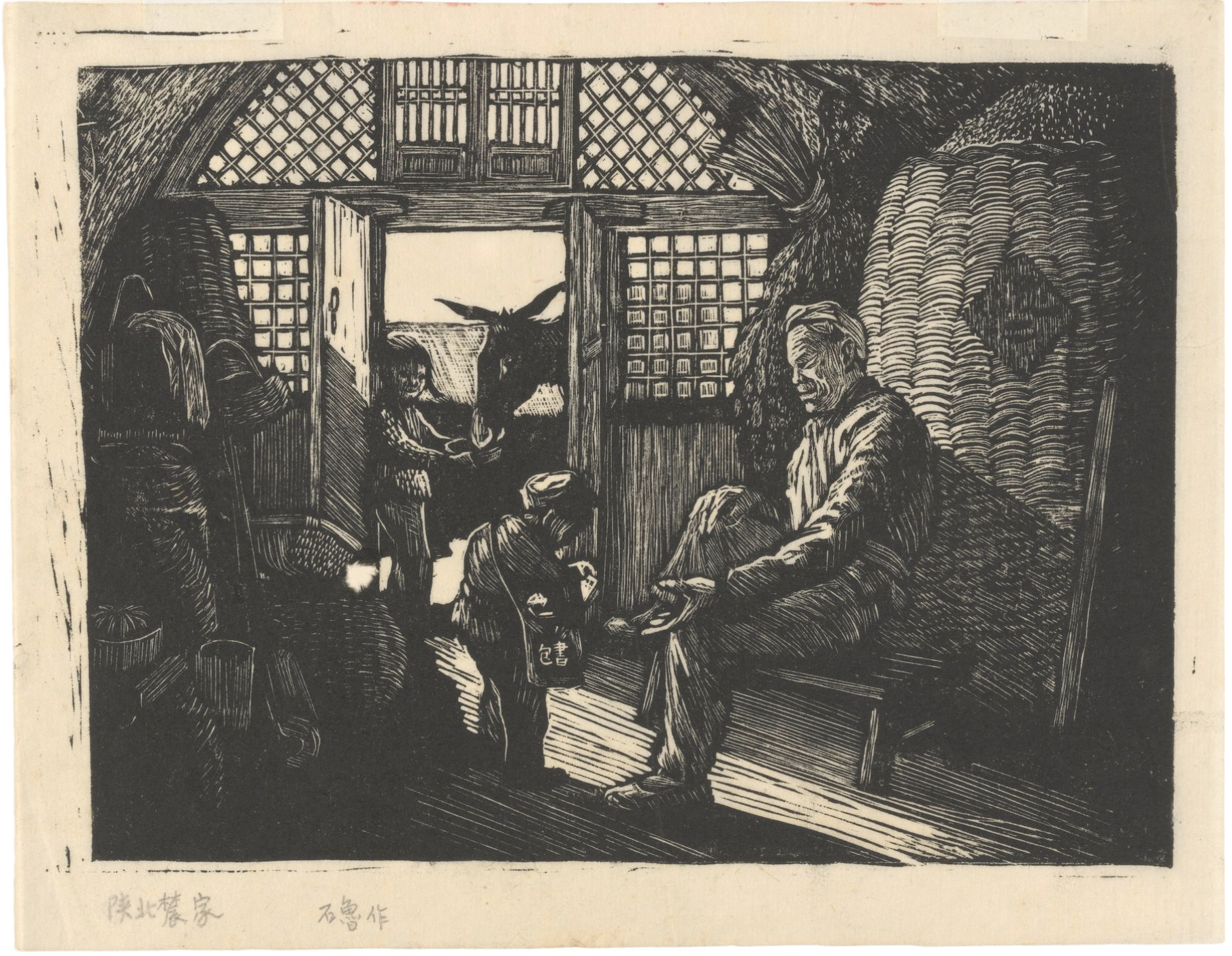
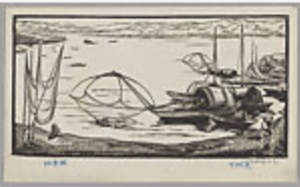
Shi Lu (1919–1982), Peasant’s Home in Northern Shaanxi, ca. 1938-1949.
The other print, Peasant’s Home in Northern Shaanxi, depicts the interior of a yaodong, the earthen cave dwelling common in the region. An elderly peasant sits before a towering stack of harvested wheat, facing a pile of woven farm implements. At the doorway, one child holds a working donkey, while another takes a book from a schoolbag and shows it to the older man. The print evokes a quiet scene of rural life after the harvest in the Communist base area. Particularly striking is the perspective, which looks outward from within the yaodong. This viewpoint suggests the artist’s identification with the domestic interior, rather than presenting local life as something observed from outside.
Taken together, the two prints demonstrate Shi Lu’s ability to move between scenes of collective political life and moments of intimate rural experience. In both, he uses decisive carved lines and stark black-and-white contrasts to convey not only the political ideals of the revolutionary base at Yan’an, but also the texture of daily life within it.
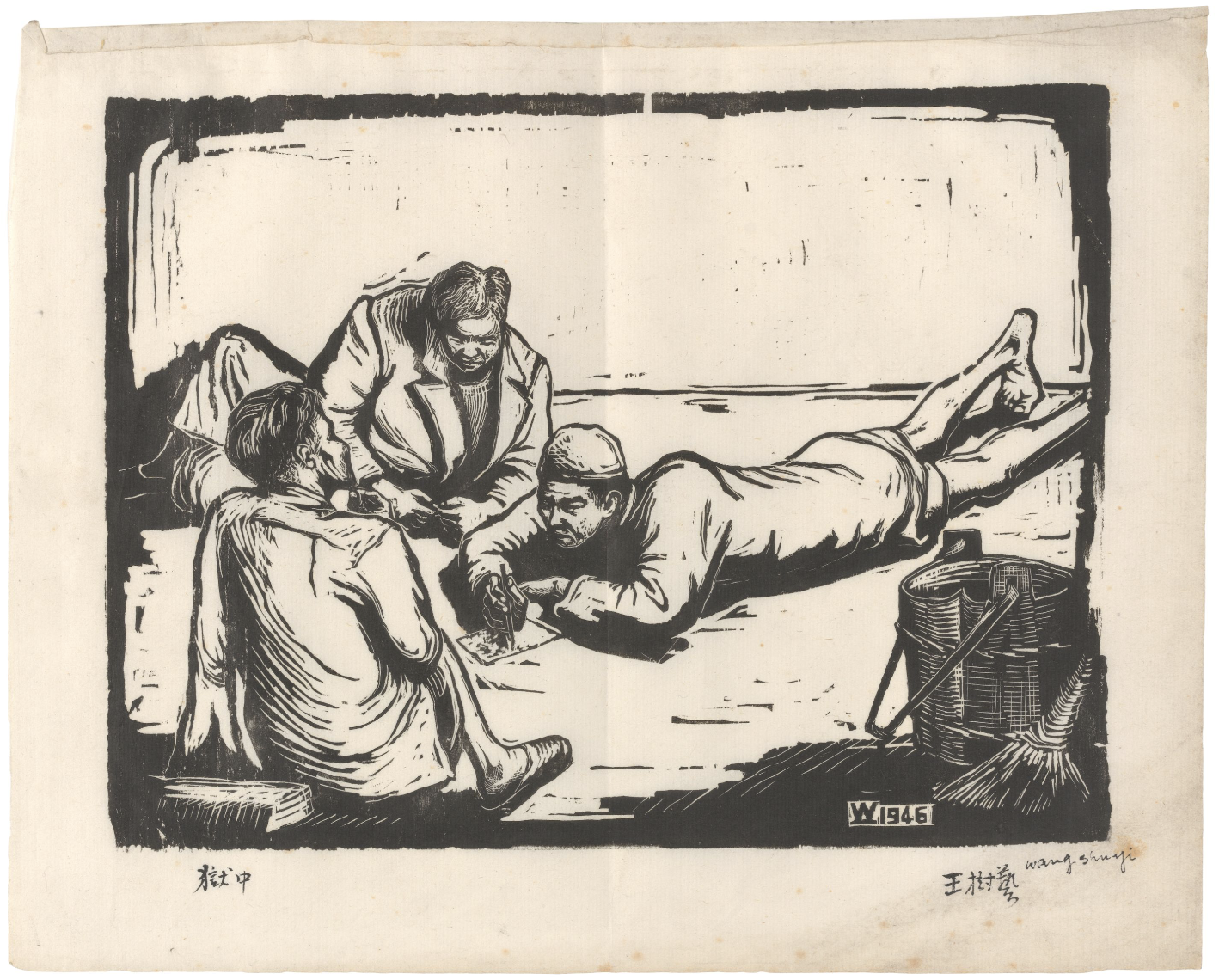
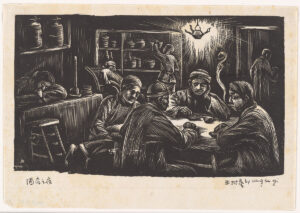
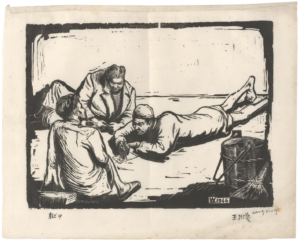
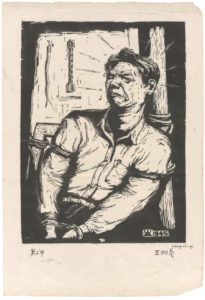
Wang Shuyi (1917–1999), Life in Prison, 1946.
Born in Bijie, Guizhou, Wang Shuyi emerged from the same left-wing artistic milieu that shaped many modern Chinese woodblock printmakers. Initially trained in Chinese painting, he joined the Prairie Art Research Society (Caoyuan Yishu Yanjiushe) in 1934, where he took part in revolutionary cultural work. Like Shi Lu, he turned to woodcut under the influence of Lu Xun and the broader New Woodcut Movement. In 1942, he entered the Art Department of the National College of Social Education (Guoli Shehui Jiaoyu Xueyuan), and after 1949 remained active in Guizhou and nationally as a printmaker.
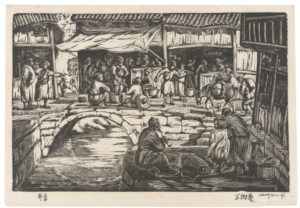
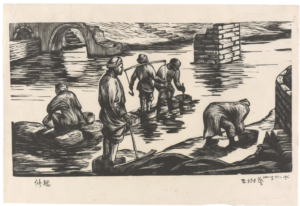
His prints often depict scenes of ordinary life with remarkable economy, using areas of open space and fluid, curving lines to animate the composition, qualities well represented by four of the works in this acquired group. The other two, however, belong to a darker chapter of his career. Depicting scenes of imprisonment, they derive from material he developed after his arrest in the mid-1940s. Following his release, he transformed those experiences into a woodcut series of more than ten prints under the collective title Disappeared Without Trace, works that later came to be valued as rare visual documents of prison life under Nationalist rule.
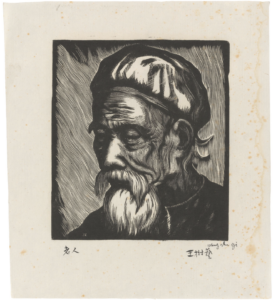
The provenance of these works adds another layer of significance, as they come from the collection of Peter Townsend, a British sinologist, writer, and editor whose engagement with modern China was unusually direct. During the Second World War, he traveled to China with the Friends Ambulance Unit and later worked with Chinese industrial cooperatives, experiences that took him deep into the country’s wartime and revolutionary world. During those years, he began to collect contemporary Chinese woodcuts and developed relationships with leading cultural and political figures, including Zhou Enlai and Mao Zedong. After returning to Britain, he became a respected presence in the postwar art world as editor of Studio International and later Art Monthly, while continuing to champion modern Chinese art through his writing, friendships, and collecting. His engagement also extended to writing on revolutionary China, most notably in his 1955 book China Phoenix.
The acquisition of these prints extends JoAnn Edinburg Pinkowitz’s passionate commitment to works on paper that unite artistic force with historical experience. She was drawn to printmaking not only for its visual immediacy, but also for its power to articulate political conviction, social transformation, and the dignity of ordinary life. In 2024, more than 300 prints by artists from or working in Mexico from the Pinkowitz Collection entered The Metropolitan Museum of Art, building on the Department of Asian Art’s acceptance in 2023 of an earlier group of 31 twentieth-century Chinese prints, among them two works by Wang Shuyi. Together, these gifts helped lay the groundwork for the special exhibition Democratizing Prints: The JoAnn Edinburg Pinkowitz Gift in spring 2025.
These latest acquisitions by Shi Lu and Wang Shuyi represent a vital expansion of the Pinkowitz Collection's current holdings. While these works share the scholarly and social spirit of the prints now at The Met, they stand as a distinct continuation of the collection's commitment and growth, further deepening its engagement with revolutionary print culture while enriching its overall historical range and intellectual character.